Friday, 29 January 2016

Maude Egerton King Obituary Part 2

Following on from my previous post of Greville MacDonald’s Maude Egerton King 1867 – 1927 – A Portrait in Miniature 'Maude Egerton King 1867-1927', MacDonald continues:


Maude Egerton King 1867 - 1927
A Portrait in Miniature
"Maude King’s writings, verse or prose, would have ranked perhaps with the greatest had her ceaseless upholding of those who were sorrowful, foolish or crippled, allowed more freedom to her pen.  Nevertheless she gave us many poems that were perfectly cut gems, as well as a fine array of stories and essays rich with her own poetic wayside flowers –


“The dark sweet violet, still hiding low,
And over the hedge in golden dance and glow
The jocund daffodil, -"
(Young Tree in Spring, My Book of Songs and Sonnets)

wayside imagery and radiance that still must brighten the future for us.

"Though subscribing to no creed or dogma, her faith in an all-pervading, immanent Beauty, whether in men, women and children, or in fertile valleys and snow-clad mountains piercing the eternal blue, or in folk-lore and great literature, tempts us to rank her religion as more convincing, saner in its appeal to and hold upon us, than much that relies upon ecclesiastic interpretation.  In the simplicity of her belief and her almost Calvinistic submission to duty in great and smallest things, we understand the purity and strength of her vision as well as the facility of her art, the spontaneity of her pathos and wit.  For this vision was fearless.  Indeed it was almost ruthless in its penetration, and her satire could be scathing when it had to be, though never bitter, never cynical.  Her eyes, no more astigmatic or myopic than their lovely physical counterparts, need no smoked glasses to protect them from the sun, nor rose-coloured to beautify the commonplace.  They never misled her in anything she did or criticised; and this in spite of environmental exactions which in many less faithful would endangered their art:

“When Fate, blindfold and move we are not whence,
Smites greatest men, oftimes they, disendowed
Of common life’s completeness, wander bowed
Through gates of loss to some large recompense;
As when, with passion and insight thrice intense,
Blake’s holy madness wrapped him from the crowd
To show him heavens in hells, and there allowed
Sight of life’s central firs: or, reft of sense
To outer noise, Beethoven clothed in sound
All love, all loss, all life’s supremest dower:
Or Milton in his house of lasting night
With God and his great heart, there within found
Large liberty and comfort, and the power
Of prophet vision undistraught of sight.”
 (My Book of Songs and Sonnets)

"In the little ballad also, “The Making of the Poet”, she claims that it is not enough to be born a poet : he must suffer also.  Here only the breaking of his lyre – the discovery perhaps that even his artistic facility is of small worth – and then the death of his lady, set him free with his hitherto unfathomed power:

“There he stood, his hair’s young golden
Dragged with thorns and dank with dew,
Wan and wild his face and olden,
Then the God Apollo knew,
Though the music had arisen
That the dart that oped its prison,

Pierced his heart, and lay there letting
Throbbing life-blood fall with song;
And its hidden fiery fretting
Made the music sad, and strong;
Till in tears of rapture glistening
Gods and men alike were listening.
(My Book of Songs and Sonnets)”

Friday, 22 January 2016

Maude Egerton King 1867 - 1927


The Haslemere Educational Museum hold a copy of Greville MacDonald’s Maude Egerton King 1867 – 1927 – A Portrait in Minature.  This short book was “Printed privately for friends” for Christmas 1927.  The museum’s copy is inscribed “With Dr MacDonald’s Christmas Greetings”.   

I think that there is no better way to understand Maude's impact on her family and peers than to read this book.  It is interesting to observe that in the year of Maude's death, Greville MacDonald also lost his wife, and yet I have found no record of another publication being produced for Christmas in her memory.

The book begins with a poem which I believe Greville wrote specifically about Maude:

“In my long life there be just three or four
Of women who, now shrined as saints, do wait
To ope for me their minster’s cloister-gate –
And One, perchance, its sunny western door.
So weary now, her dear help I implore,
Lest, faithless to my spade and hoe, I bate
My golden dream that, very soon or late,
I’ll doff the cowl and cross the immortal floor.

“Those peerless saints!  Of whom that One doth glow
Still with her ruby heart of flame, her eyes
Of speedwell blue.  Angelic her emprise
To make red roses e’en in my garden grow!
Herald of Beauty here, she trod God’s ways,

And now has left to Him all Death’s dismays."

And then the book formally begins:

“Portrait painters should be poets, for although, say, a rose’s outward visible form may be glowingly portrayed in a drawing, its inward spiritual beauty will for some find surer expression in a song.  Similarly while the writings of Maude Egerton King, and her devotion to Peasant Arts with the Guild of that name, do give close understanding of herself; yet and although the skill of poet and painter be lacking, it seems right to venture this record of her peerless nature, especially as it expresses the convictions of those most intimate with her person and her life (footnote 1– I have been helped much by the sanction and criticisms of her husband, sisters and some oldest friends).  If, to quote William Blake, “the fool sees not the same tree that the wise man sees”, it is no less true that two angels may behold the same tree’s beauty quite differently, the perception of beauty being always subjective.  So, while the impossibility of doing justice to the present theme will be realized in its very endeavour, the general accuracy of it will not be questioned.

Perhaps some day her whole story may be told, for the simplest details of a noble life often prove entrancing literature (footnote 2 – This fact is nowhere better shown than in her first prose-work, Round About a Brighton Coach Office, 1896).  At present it can only be affirmed from the words of sisters and earliest friends, how Heaven lay about her in her infancy, and how it has been given to them, and to others of us, to recognize that influence in all her writings, as well as in the social world she fashioned and ruled so sweetly with unseen sceptre.  Many say they won a renewal in education, even inspiration, from her very person and atmosphere; a revelation, indeed an unveiling of the Kingdom.  “The spirit of man is a candle of the Lord searching out the innermost parts”, wrote Solomon.  Hers was a candle with neither smoke nor flicker in its flame.  Not to many is it given thus to hold the torch through the terrestrial way, even for their intimates.  Yet some illuminate worlds themselves perhaps had not yet fully seen ; and in such wise that their torches still flame, perhaps with increasing brightness, even after they have left us weeping.  Thus indeed, as with all great musicians, painters and poets,

“The future brightens on our sight,
For on the past hath fallen a light
That tempts us to adore (Wordsworth, Elegiac Stanzas)”

To be continued!


Sunday, 10 January 2016

The Peasant Village at Haslemere Museum

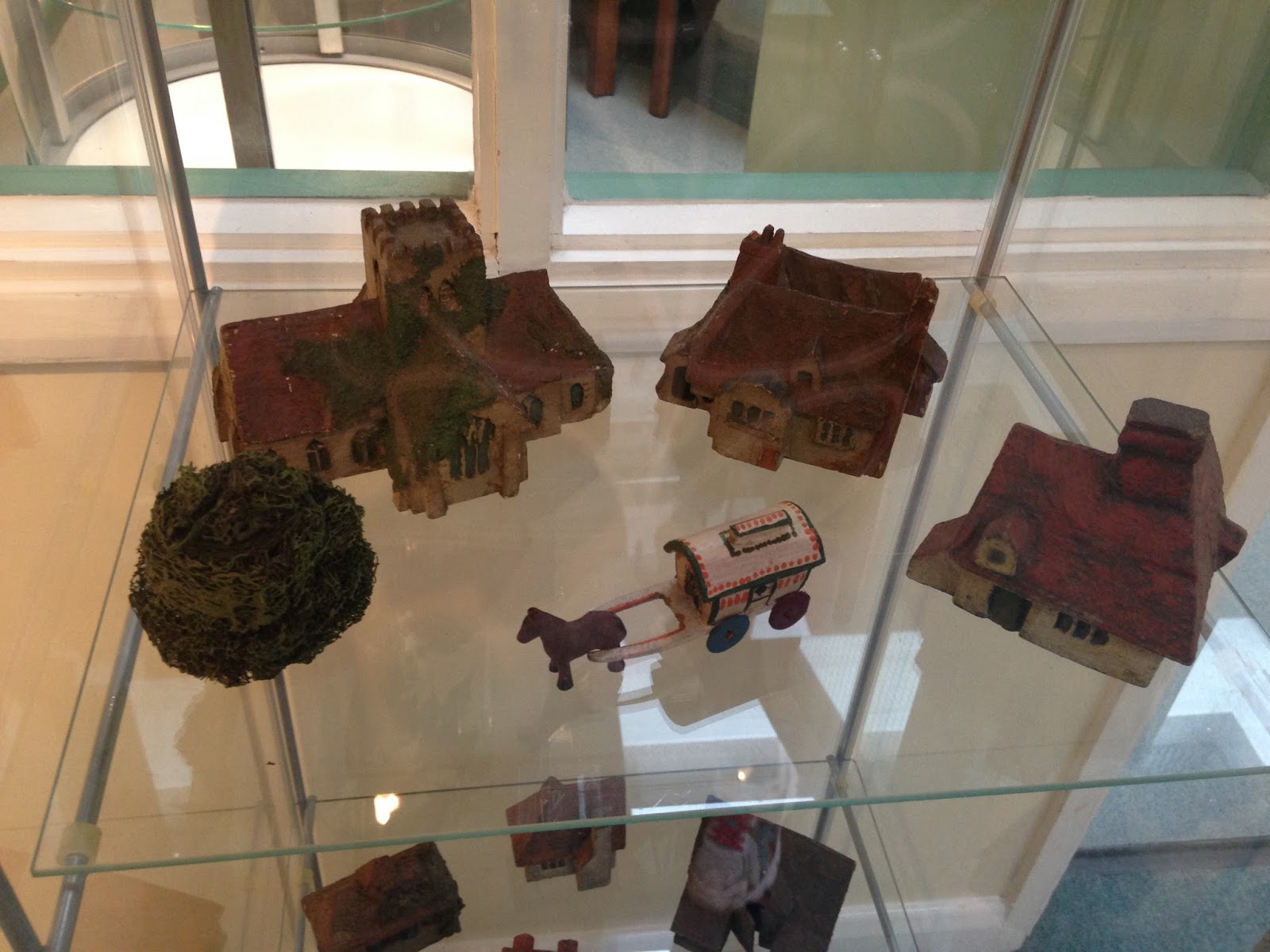
The current History of Haslemere exhibition at the Haslemere Educational Museum (which runs until 30th January 2016) includes a small cabinet display of some of the Godfrey Blount toy buildings.  These are rarely on display.  It is interesting to see them in person as they are so much smaller than you might imagine a toy building would be.  Some toy cows and a horse and gypsy cart accompany them.

Peasant toy buildings and cows by Godfrey Blount,
Haslemere Education Museum


The making of the toys at the John Ruskin School, Haslemere was described in the advert below as "The school has been founded in the hope of showing that the spirit of joy and imagination, which is obvious in the creation of toys, should inspire all true labour and culminate in the making of the highest religious symbols."

Advert for the toys produced by the Peasant Arts movement
Looking at the June 1943 obituary of Mrs Godfrey Blount recently, I noted that it said that she was "herself an expert maker of wooden toys and skilled in various forms of craftsmanship", so perhaps the association of these buildings solely with Godfrey Blount is unfair.

 
at Haslemere Educational Museum

Toy buildings and horse and gypsy cart by Godfrey Blount,
Haslemere Educational Museum

Toy buildings by Godfrey Blount,
Haslemere Educational Museum


Friday, 8 January 2016

Maude Egerton King - Obituary

On the 23rd April 1927 the Hull Daily Mail reported "Woman Author's Death":


"Haslemere, Saturday - The death took place at Haslemere of Mrs Maude Egerton King, wife of Mr Joseph King, formerly MP for North Somerset, in her 61st year.

"Mrs King was the youngest daughter of the late Mr Henry G. Hine, the well-known water-colour painter, and she married Mr King in 1887.  She was well known for her literary activities, and was prominently associated with the movement for the revival of peasant arts.  In 1894, Mrs King founded, in conjunction with her husband, the Haslemere weaving industry, where women workers are employed on hand looms, and for several years she was hon, secretary of the Peasant Arts Guild.

"In 1910 she founded the "Vineyard," a monthly magazine, and edited it for several years, and she was the author of several volumes of prose and verse."

The same article appeared in the Surrey Mirror.  The Gloucestershire Echo titled the article "Death of Mrs M. E. King, Reviver of Peasant Arts", the Western Daily Press "Her Work in Reviving the Peasant Arts" and the Derby Daily Telegraph "Her Interest in Peasant Arts".

Maude Egerton King's obituary,
Hull Daily Mail, 23 April 1927

Saturday, 2 January 2016

In Vigilia Nativitatis, December 1913

The December 1913 edition of The Vineyard included the following poem by James Archibald Campbell, a writer I am still keen to discover more about.

The Flight Into Egypt by Arthur Hughes
Frontispiece, The Vineyard, December 1913


A young pine stood there, gaunt, on high,
Against the leaden northern sky;

Cold as abstractions, made abstruse,
Sharp as an argument's abuse.

Just then a little boy went past,
And clasped his hands around its mast.

"How strong it is, and brave !" said he,
"God meant it for a Christmas Tree,

To scare with lights dark night's alarms,
And carry gifts on all its arms.

Father, do young tree's fingers too
Get nipped by frost, as children's do

We'll dress it in the warm fire's glow
Where Santa Claus goes to and fro,

Then plant it, sheltered from the snow,
Till the dear Christ Child makes it grow!"

Friday, 18 December 2015

Maude Egerton King's grave restored

Following on from finding Maude's grave at St Bartholomew's cemetery in the Summer, the church and the Haslemere Educational Museum have been incredibly helpful in restoring and preserving Maude's grave.

Maude Egerton King's gravestone, December 2015


  • Philip Hunt, St Bartholomew's Churchyard representative managed to persuade Waverley Borough Council to clear the site of Maude's grave, and the grave site was cleared at the beginning of December
  • Haslemere Educational Museum agreed to take custody of Maude's deteriorating wooden grave marker, and it is now currently drying out at the museum in a controlled environment
  • I am now looking after Maude's grave in the absence of any next of kin!
Maude Egerton King's overgrown grave, Summer 2015
Maude Egerton King's grave, December 2015

Maude's grave was barely visible in the Summer, as the site was overgrown with shrubs and brambles.  The recent cut back reveals the gravestone to Maude and her daughter Katharine King.


Maude Egerton King's grave marker, drying out in transit to
Haslemere Educational Museum

Maude Egerton King's grave marker, drying out in transit to
Haslemere Educational Museum


We decorated Maude's grave with four ivy crowns, fresh from the Tree Dressing Ceremony at the Weald and Downland Open Air Museum.  I would like to think that Maude may have supported such an event which celebrates the English folk traditions.  I think that the simplicity of a crown fashioned out of ivy from the Sussex woods could have appealed to her.  I hope she likes them.


Sunday, 4 October 2015

The Spies - no longer under cover at the V&A

It is wonderful to see that the Haslemere Peasant Industries' The Spies is now on display in the Victoria & Albert Museum.   When I last visited in 2013 the 'Haslemere Peasant Hanging' (in this blog post) was on display in the Arts and Crafts gallery.  My understanding was that it had been on display here for some time.  When I inquired recently about seeing The Spies at Clothworkers Hall, where the V&A keep their textile storage, I was surprised to hear that The Spies was actually on display the V&A, at gallery 125 on the 4th Floor.  So back I went.

The Spies on display at the Victoria & Albert Museum,
gallery 125, October 2015

When I had visited in 2013, my opinion was that the 'Haslemere Peasant Hanging' was shown as the centrepiece of the Arts and Crafts main gallery.  Upon visiting on Friday, I now see that there was a bigger, central space in the gallery which now has The Spies hanging there.  The hanging that was there in 2013 clearly did not capture my interest!  I'm not sure what it was, but The Spies looks much better there now!  Comparing the 2015 and 2013 photographs, I cannot see that much, if any, of the other exhibits in that room have changed.  How nice to remove one Haslemere piece and put another Haslemere piece back.  I wonder if there was that thought behind the display?

'Haslemere Peasant Hanging' at the Victoria and Albert Museum,
gallery 125, January 2013

The space the 'Haslemere Peasant Hanging' occupied in 2013 is now home to Voysey's 'Owl' furnishing fabric, shown here in the V&A's library.   The same source states that the 'Haslemere Peasant Hanging' is in storage, here.

The Spies, handwoven and embroidered linen,
by Godfrey Blount, Victoria & Albert Museum online here

It was very interesting seeing The Spies in real life and hanging on display, after having examined it so many times online.  Whilst the 'Haslemere Peasant Hanging' is an arresting piece in it's bright and stark simplicity, The Spies demonstrates the enormous skill of the movement.  Having been owned by Joseph King, it seems highly likely that The Spies is one of the most significant pieces made by the Peasant Arts movement.  It is not just the visuals but the Bible story that is behind the scene depicted (which I explored in my post here), and the knowledge that this was also depicted above the entrance of the King's home, Sandhouse.  

The Spies
on display at the Victoria & Albert Museum

The Spies
on display at the Victoria & Albert Museum

The Spies
on display at the Victoria & Albert Museum

In Country Life (27 August 1910) 'Homes, Gardens, Old & New' the entrance to Sandhouse is described "Below, an octagonal porch juts out in very interesting fashion.  On its face is a large plaster panel brilliantly coloured.  The walls of the house are of rich red brick diapered with blue, and by a happy chance some of the blue bricks by the porch have turned green, and so pick up the green which, next to the purple of the giant grapes, predominates in the plaster panel."  I expect that the plasterwork would have been that of Godfrey Blount, the Kings' brother-in-law.

The Spies, plaster panel above the porch to Sandhouse,
Country Life  (27 August 1910)

In gallery 125 it was interesting to see that the book guide to the room has 2 pages of photographs of the Haslemere movement.  I did not look at this, if it was there, last time I visited.


'Question of Design', book in gallery 125,
Victoria & Albert Museum,
with 2 photographs of the Haslemere Peasant Arts movement

The furniture in front of The Spies is:
  • 18. Lectern (1903-1904), designed by architect Charles Harrison Townsend
  • 19. Cabinet (1893), designed by George Washington Jack, made by Morris & Co.
  • 20. Chair (about 1883), by A.H. Mackmurdo


Related Posts Plugin for WordPress, Blogger...