Sunday, 22 December 2013

An English carol collected by Cecil J. Sharp

In The Vineyard (December 1911), Cecil J. Sharp wrote an article called "The Moon Shines Bright".  Sharp describes:

Mrs. Handy and her husband, from The Vineyard (December 1911),
'The Moon Shines Bright' by Cecil J. Sharp

"I collected this beautiful variant of a well-known English carol from an old lady, Mrs. Handy, a native of Tysoe, now living at Ilmington, Warwickshire.  She was one of a large family, seventeen, I think she said, and she and her sister, when they were all living at home, used to go out on Christmas Eve every year and sing this and other carols outside the houses of their friends.  This, like many another old custom, is now, unhappily, fast dying out, and he who would collect the old carols before they have irrevocably passed away must not wait till Christmas-time to bear the, but must go betimes to the old singing men and women and prevail upon them to sing to him what they can remember,  Thus has been my practice for many years, with the result that I have now quite a nice number of old carols hidden away in my notebooks.

"The Moon Shines Bright" was at one time an Easter carol, but for many years it has become attached to the season of Christmas.  The tune is in the Dorian mode, although the flattened sixth in the penultimate bar gives an Aeolian flavour to the fink cadence.

As Mrs. Handy could only remember the rods of the first two stanzas, I have had recourse to a set of words which were recited to me many years ago by a very old lady living at East Harptree, Somerset. "

The Vineyard (December 1911),
'The Moon Shines Bright' by Cecil J. Sharp


"The moon shines bright and the stars give a light
A little before it is day;
Our Lord our God He called on us
And bids us awake and pray.

Awake! O awake!  good people all,
Awake! and you shall hear;
Our Lord our God He suffered on the cross
For us whom He loved so dear.

The fields were green, as green could be,
When we from His glory fell;
And we His children then were brought
To death and near to hell.

The ice of a man it is but a span,
It's like a morning flower;
We're here to-day, to-morrow we are gone,
We are dead all in one hour.

O teach them well your children, dear man,
While you have got them here;
It will be better for your soul, dear man,
When your corpse lies on the bier.

To-day you may be living, dear man,
With a many thousand pound;
To-morrow you may be dead, dear man,
And your corpse lie underground.

With the green turf at your head, dear man,
And another at your feet;
Your good deeds and your bad, dear man,
Will all together meet.

My song it is done and I must be gone,
No longer can I stay here.
God bless you all, both great and small,
And send you a happy New Year."

Christmas in Fairyland by Greville MacDonald

I haven't posted for a while, so a Christmas post is needed.

Illustration by Godfrey Blount, The Vineyard, December 1911,
from 'The Christmas Tree' by Maude Egerton King

In Greville MacDonald's enchanting fairytale Jack & Jill, a fairy story (J.M.Dent & Sons, London, 1913)  a Christmas scene is described that is reminiscent of some of the Haslemere Peasant Arts' ideals, but not the aspect of being sad because of a naughty dragon:

illustration by Arthur Hughes, from
Jack and Jill, a fairy story (MacDonald, Greville, J.M.Dent & Sons, London, 1913)

“They were walking down the High Street.  The shops had no glass in front.  They could see the fairy people all busy, though most of them silent and sad.  Some were weaving and spinning; some making toy furniture, carts and wheelbarrows; other were making shoes or clothes, fashioning little flags and Christmas-tree ornaments: some threading beads  and shells, and some painting wooden toys.

“Curdie,” aked Jill, “can we buy things without money like we did the apples?”
“Yes, Miss Jillie,” the good dog answered, “anything we need and have paid for.”
“How can we without money?” asked Jack.
“By doing work.”

Then Jill took her spindle and distaff, both of which she had been carrying under her arm, and began to be very busy.  Jack got his knitting needles out of his sabretache, set his sword-belt straight, half drew his sword as if to see that it had not rusted in its scabbard, set his cocked hat on one side, and began to knit.”

illustration by Arthur Hughes, from
Jack and Jill, a fairy story (ibid.)_

Tuesday, 12 November 2013

Arthur Romney Green's table at Charterhouse

Following up on a reference in Arthur Romney Green's biography to a refectory table at Charterhouse School, down the road from Haslemere in Godalming, I have heard back from them, and it is not good news.  

Susan Elkin reported that Romney Green did some work for Charterhouse "including the big oak refectory table for Hodgsonites House, a photograph of which he used for advertizing purposes"  (Elkin, Susan, (Life to the LeesCromwell Press, 1998).  I thought that this work was probably made for Charterhouse following the Master of Charterhouse, Gerald Davies', interest in arts and crafts, and the sale of his peasant arts collection to the Peasant Arts Guild in 1908.   Sadly I have not found the advert that is being referred to.
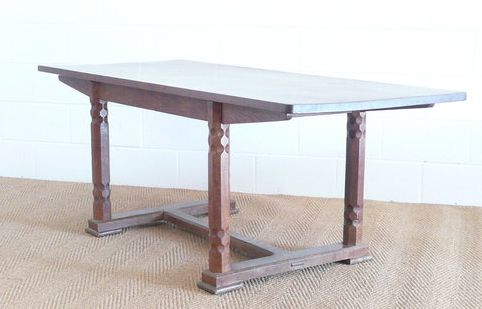
Arthur Romney Green oak refectory table
with octagonal leg detailing
for sale at antiques-atlas
Charterhouse's archivist has told me "We have not been able to identify Green’s big oak refectory table in Hodgonsites House.  Although all the Houses still have long refectory tables in their dining halls (as you will be able to see if you just look through the windows of the Central Dining Rooms on the left as you drive into Charterhouse) I am not aware of any particularly decorative Arts and Crafts tables and the Housemaster of Hodgsonites tells me that there is nothing of that nature in the boarding house. 

"The boarding Houses were still run as private enterprises by each Housemaster in the Edwardian era, so the table would presumably have been commissioned by T E Page, a distinguished Classics teacher, who taught at Charterhouse from 1875 to 1910 and was Housemaster of Hodgsonites between 1881 and 1910.  The original Hodgsonites boarding house was demolished in the 1970s, together with six other Houses, and they were relocated in new buildings, so it is possible that the table was lost at that point. "

Interestingly, there is an Arthur Romney Green "oak refectory dining table" currently for sale on antiques-atlas: "A Cotswold School oak refectory dining table designed and made by Arthur Romney Green c.1920. Signed "ARG". Octagonal legs with scalloped decoration. Pegged construction throughout."  I wonder if the refectory table at Charterhouse looked like this.  The table legs have a very similar design to the altar chair in St Christopher's Church, Haslemere which my photographs do not do justice to.

Arthur Romney Green altar chair,
with octagonal leg detailing
St Christopher's Church, Haslemere

I have also found this photograph of Standen, the National Trust Arts and Crafts property, which says that the table at the bottom of the staircase is by Arthur Romney Green, the legs here do look like they have similar octagonal shaping.  As I discovered from looking at previous Arthur Romney Green items for sale in another post, Arthur Grogan, the curator of Standen collected Arthur Romney Green works.

Arthur Romney Green oval table at Standen, National Trust house
from ViewPictures 

Friday, 1 November 2013

Luther Hooper, the Country Church and Non-Fine Art

Luther Hooper's article that accompanied the photographs in The Art Journal ('Art of To-day.  Fine and Otherwise', February 1911, pp47) demonstrates his allegiance to many of the beliefs of the Peasant Arts movement.

Luther Hooper's article in The Art Journal February 1911
"It is necessary, when treating of any subject on which there may be differences of opinion, at the start to clearly define the meaning of the principal terms under consideration.  Words convey such different ideas when used by different persons, especially when they do not signify anything that can be seen or handled.  The meaning of the word art, therefore, if our subject is to be profitably discussed, must first be agreed upon.

It is only in recent times that the word Art, with a capital letter, has come to express something apart from ordinary mechanical work.  In former times the word artist meant the same as artificer, so that weavers and joiners, goldsmiths, blacksmiths, builders and other mechanics, as well as painters, sculptors and musicians, referred to their trades as "arts and mysteries."  An old lexicon gives the definition of art as science, skill, crafts, cunning.  Artificer and artist were, therefore, in the old times interchangeable terms.  What used to be called as art we now call craft, and Art is popularly represented as an attenuated, delicate and sad-eyed female, dressed in clinging garments, rising from her embroidery frame or painting easel, to take the horny hand of Craft - clad in leather aprons and paper cap, fresh from the stithy or carpenter's bench - suggesting to him a pleasant stroll together through groves of flowering roses and ripening pomegranates.

Reredos of carved and painted wood in The Country Church, Haslemere,
designed and carved by Godfrey Blount
The Art Journal, February 1911(- online version)
Reredos of carved and painted wood in The Country Church, Haslemere,
designed and carved by Godfrey Blount
The Art Journal, February 1911 (- National Art Library version)

This view of art patronising or supplementing labour is not a true or healthy one.  It is as false as the prevalent idea that the artist, as we call him, can take up a piece of work where the mechanic leaves off, and by adding ornament to it, make it beautiful.  It is true that by skill and cunning the defects of inferior and ill-considered workmanship may be, to a certain extent, modified or disguised, but such applied decoration, however successful, is at the best only unsatisfactory compromise the necessity for which should never have arisen.

The prevailing belief that the artist, or ornamentist, as he should be called, is necessarily superior to the craftsman is answerable for much of the misconception with regard to decorative work which prevails to-day.  It is also answerable for many sad examples of inferior workmanship which one sees and deplores at the various places where such wares are exhibited and offered for sale.  It seems to be thought by many that an "artist" can easily learn the mysteries of an craft, and that his work must necessarily be better than that of the workman who has devoted all his time to the learning of his trade and acquiring mechanical skill in its practice.  This is manifestly an error, for it is obvious that no beauty of design or ornamentation can make up for faulty construction and inferior workmanship.  It is no doubt due to the system of specialising in all branches of modern work, by means of which all individuality is eliminated, that the word art has come to be understood in such a restricted sense, and that, at best, an artist of to-day is one who attempts to embody his conceptions of truth and beauty in form and colour in such a manner as to render them intelligible to other persons.  The old idea is far preferable, viz., that any labourer who does his work with science, skill and cunning is an artist, and if his work with science, skill and cunning is an artist, and if his work be done with sincerity and enjoyment, it will be spontaneous and beautiful in just such measure as he has had, and used, his opportunities of cultivating his sense of beauty, proportion and fitness.

In the present series of papers, then, the word art is to be understood in this wide sense.  It is proposed to investigate and illustrate the work of to-day in various branches of industry and consider each example as a whole.  Choice of materials, design, mechanism, construction and degree of finish are all comprised in the word art, and will be pointed out and commented on.  Only one kind of art, thus comprehensive, will be considered as fine; for the writer is confident that the same quality of inspiration moves the humble potter to shape and decorate a cup and platter, the village mason to cut an inscription on a tombstone in beautiful lettering, the Bavarian peasant to carve in wood the rapt figure a saint, and the responsible architect to design and superintend the building of a vast cathedral, the eminent painter to immortalise on canvas the Beauty of the day, or the fashionable sculptor to model the statue of a Divinity.  All are exercising, perhaps in different degrees, one and the same equally fine science, craft, cunning, or, in one word, art.


The Country Church, East End Recess,
Designed and Modelled in Plaster by Godfrey Blount
The Art Journal, February 1911(- online version)

Bearing in mind the above definition we now turn to the immediate subject of this and the following paper, which is Art in the Church.  Here one would supposed that the best efforts of the artist would be continually in demand and that all the fittings and furniture would be the best obtainable.  That this is generally far from being the case, the most casual visitor to our churches of all denominations cannot fail to notice.  The church furnisher, whose one idea is profit, reigns supreme, and whether in finely designed and well constructed modern buildings or in ancient fabrics mellowed by time, the furniture and fittings are for the most part meaningless, cheap and uninspired, or gaudy, pretentious, and inharmonious.

The Country Church, East End Recess,
Designed and Modelled in Plaster by Godfrey Blount
The Art Journal, February 1911(- National Art Library version)

In the church, if anywhere, everything should be made or carefully selected for its special place and use; all should be of the best of its kind and in harmony with all the rest.  In fact art, in the church particularly, should be alive.  This can never be if things are used which have been made at the lowest rate simply for money, and safely stocked by the tradesman and sold merely for profit.

Examples of live art may be seen in a little country church at Haslemere in Surrey, which belongs to no particular sect.  It is called "The Country Church" and has been fitted and is being enlarged and carried on by its founder an artist, poet, thinker, seer or what not.  Anyhow one has but to enter it, at any time, to feel that religion is alive there, whatever it form may be.  Originally a watermill, when the water was drained an upper floor was added and it became a weaving-house.  Now in the course of years it is a church, and all its appointments exhibit inspired thought and loving labour..."

Wednesday, 23 October 2013

Reredos at the Country Church, Kings Road, Haslemere

The picture of this reredos has been hard to find as the online version of the Art Journal (February 1911) is so badly scanned that the page is black apart from the altar cloth design.  Having only seen this as a black page previously I was pretty blown away by the picture.  The woodwork is incredibly detailed and was clearly painted a number of colours.

Reredos of Carved and Painted Wood in the Country Church, Haslemere,
designed by Godfrey Blount
from Art Journal, February 1911

The Country Church building was also known as St George's Hall and stood where St Georges Flats now stand on Kings Road.

East End Recess of the Country Church,
designed and modelled in plaster by Godfrey Blount
from Art Journal, February 1911


Friday, 11 October 2013

Peasant Literature

I am attempting to create a bibliography of the books, journal articles and references written by or about  the Haslemere artists on Kings Road, Haslemere c.1900:

  • Godfrey Blount
  • Ethel Blount
  • Joseph King
  • Maude Egerton King
  • Greville MacDonald
  • Luther Hooper
  • Arthur Romney Green
This is under-construction (I am not sure when it will ever be fully completed!) on a separate page 'Literature'.  Where there is an online copy of the book or journal, it is hyperlinked into the reference.

The Spies on tour & on the move

In my post about The Spies I looked at the Haslemere peasant industries panel c. 1900 that is in the Victoria & Albert Museum's collection.   Having recently re-visited the museum's online entry for this work I noted that there is an 'exhibition history' entry for this item which I had not seen before.


The Spies, Haslemere Peasant Industries panel c.1900
designed by Godfrey Blount

Whilst the panel is marked as 'in storage' it has been viewed across the globe: in the United States and Japan.

"Exhibition History
Life and Art: Arts and Crafts from Morris to Mingei (Aichi Prefectural Museum of Art, Nagoya 12/06/2009-16/08/2009) 

Life and Art: Arts and Crafts from Morris to Mingei (Metropolitan Art Museum, Tokyo 24/01/2009-05/04/2009) 

Life and Art: Arts and Crafts from Morris to Mingei (The National Museum of Modern Art, Kyoto 13/09/2008-09/11/2008) 


International Arts & Crafts (Fine Arts Museums of San Francisco 18/06/2006-18/08/2006) 


International Arts & Crafts (Indianapolis Museum of Art 27/09/2005-22/01/2006) 


International Arts & Crafts (V&A 17/03/2005-24/07/2005) 


Textiles of the Arts and Crafts Movement (V&A 01/01/1988-31/12/1988)" V&A online 


The V&A have been re-housing their textiles in storage.  I believe that this piece and their Luther Hooper works are now in the Clothworkers' Centre for the Study and Conservation of Textiles and Fashion which opened earlier this week (8th October 2013).  One day I hope to visit them there.

Related Posts Plugin for WordPress, Blogger...