Showing posts with label Edmund Hunter. Show all posts

Thursday, 29 March 2018

Edmund Hunter's Stag & Deer Silk Panel

This silk panel that was auctioned in 2017 shows in my mind an influence from the Haslemere Peasants.  Vine leaves, grapes and deer, it has all the ingredients of Godfrey Blount's designs.  Made by Edmund Hunter's St Edmundsbury Weavers, suggested to be made around 1900, when the St Edmundsbury Weavers were based at College Hill, Haslemere.

St Edmundsbury Weavers Stag and Deer Silk Fabric Hanging
from Lyon&Turnbull

The piece is described as:

"ATTRIBUTED TO EDMUND HUNTER FOR ST EDMUNDSBURY WEAVERS 
STAG AND DEER SILK FABRIC HANGING PANEL, CIRCA 1900  
depicting opposed stags on a vine ground, within grey silk border 
42 x 49.5cm, including border 70 x 76.5cm 
Estimate £ 200-300 "


St Edmundsbury Weavers
detail from Lyon&Turnbull

The piece sold for £1,000.


Thursday, 28 February 2013

Arts & Crafts Exhibitions & Haslemere's Peasant Arts connections

I have not seen a comprehensive listing of the works displayed at the Arts and Crafts Exhibition Society by the Haslemere Peasant Arts artists, so I have compiled one (I did not look beyond 1935).

First to see the wood for the trees, it is interesting to just look at the statistics.  Godfrey Blount and Ethel Blount had their works shown at only two Arts and Crafts Exhibition Society exhibitions, the 1896 and 1899 exhibitions.  Some of those works involved Maude Egerton King.  I wonder whether they choose not to exhibit at further exhibitions, and if so why, or were their works not accepted by the Society for later exhibitions?

Number of items exhibited at Arts & Crafts Exhibition Society exhibitions
by artists linked to the Haslemere Peasant Arts movement

F.W.Troup who built numerous houses and the Weaving House and Tapestry Studio on Kings Road, was the first artist to exhibit at the Arts and Crafts exhibitions in 1899.  Troup was first listed as a Society member in 1903 and continued to exhibit until 1931.

In 1896 five works were exhibited by Godfrey Blount in association with the Haslemere movement.

Arnold Dolmetsch also first exhibited in 1896, although he was not based in Haslemere until later, becoming an Honorary Member in 1931.

The Blounts continued to exhibit in 1899, with one piece being individually attributed to Ethel Blount.

In 1903 Edmund Hunter first exhibited his works of the St Edmundsbury Weavers, then Haslemere based, whose work was on display in St Christopher's Church, Haslemere and continued to exhibit until the 1916 exhibition.

Arthur Romney Green's work was first exhibited in 1906 when he was based in Foundry Meadow on Kings Road, in later years such as 1912, he exhibited prolifically and was first listed as a Society member in 1916.

Luther Hooper, based a few hundred metres away from Arthur Romney Green in Foundry Meadow also began exhibiting in 1906.  It is interesting that Hunter, Green and Hooper were all exhibiting in 1906, and that their work was around that time seen altogether within St Christopher's Church, Haslemere in the form of a woven hanging, altar chair and table, and wool and silk curtains respectively.


Saturday, 26 May 2012

Luther Hooper & Edmund Hunter

I have recently discovered that Luther Hooper and Edmund Hunter were in business together.  Both of these weavers had works in St Christopher's Church, Haslemere.  Luther Hooper had silk altar curtains and a wool hanging on the choir vestry, Edmund Hunter produced the altar frontal.  St Christopher's have an old postcard showing the altar curtains by Luther Hooper and altar frontal by Edmund Hunter, albeit they are a bit distant and grainy.
St Christopher's Church, Haslemere c. 1910
with Luther Hooper altar curtains and St Edmundsbury Weavers altar frontal


Luther Hooper was weaving silk and wool at the Greenbushes workshops on Kings Road, Haslemere, and Edmund Hunter was running the St Edmundsbury Weavers from Haslemere until moving to a factory in Letchworth in 1908.  The St Edmundsbury Weavers were established in 1902.  It would appear that this was a new separate venture, following the end of Luther Hooper and Edmund Hunter's joint business, the Haslemere Silk Weavers.   The London Gazette (13 December 1901) reported:

"Notice is hereby given, that the partnership heretofore subsisting between us the undersigned, Luther Hooper and Edmund Arthur Hunter, carrying on business as Silk Weavers, at Haslemere, in the county of Surrey, under the style or firm of "Haslemere Silk Weavers," was dissolved as and from the 29th day of November, 1901, by mutual consent.  All debts will be paid by Luther Hooper. - Dated the 6th day of December, 1901.
                                           LUTHER HOOPER
EDMUND A. HUNTER"

The St Edmundsbury Weavers' 'Vineyard Poplin' which formed the altar frontal for St Christopher's Church was also made in silk.  The silk version was exhibited at the Arts and Crafts Exhibition Society in 1912 (according to The Victoria Web).  It is interesting to see the different versions of this design.

Vineyard Poplin by the St Edmundsbury Weavers,
at St Christopher's Church, Haslemere

Detail of Vineyard Poplin by the St Edmundsbury Weavers

Vineyard Poplin, designed by Edmund Hunter,
Art Journal, November 1906
Vineyard by Edmund Hunter,
silk and gold thread,
maunfactured by St Edmundsbury Weavers
The Victorian Web

Luther Hooper and Edmund Hunter would continue to exhibit their works in the same forums.  Hopefully their parting was an amicable one.  In the 28th September 1906 edition of a New Zealand British Art paper  there is a list of items exhibited in the Arts and Crafts sub-section of a British Art exhibit (it's not clear what exactly the exhibition is), it is remarked that "they should be of the greatest value to local designers who are desirous of studying the best models" which includes "Handwoven Dorsel Hanging for a Small Altar, "Vine and Wheat" - Exhibited and designed by Luther Hooper, executed by Percy Hooper."  At the same time, there is an exhibit described as "Woven Tapestry, "The Forest": Chalice Veil, "Kembic" - Exhibited and designed by Edmund Hunter, A. and C., executed by Edmund Hunter and the St. Edmundsbury Weavers."

Friday, 23 March 2012

Works of the Other Haslemere Craftsmen


The Art Journal in November 1906 published an article on 'Haslemere Arts and Crafts' by R. E. D. Sketchley which covered the main craftsmen at the time.  The article contains some interesting photographs of the works of Arthur Romney Green, Luther Hooper and the St Edmundsbury Weaving Works, all of whom had work in situ at the time in St Christopher's Church in Haslemere.

Portiere in Woven Embroidery, designed by
Luther Hooper, woven at the Green Bushes Weaving House,
Art Journal, November 1906

Dining Table of Brown English Oak, designed and made for P. Debell Tuckitt, Esq.,
by Arthur Romney Green, Art Journal, November 1906

Panelled Chest of Brown English Oak, designed and made by Arthur Romney Green,
Art Journal, November 1906

Arm Chair of English Oak, with Laced Leather Seat,
designed and made by Arthur Romney Green,
Art Journal, November 1906

Gothic Tulip Tapestry, designed by Edmund Hunter,
woven at the St Edmundsbury Weaving Works,
Art Journal, 1906

St Paul Brocade, designed by Edmund Hunter, woven at the St Edmundsbury Weaving Works,
Art Journal, November 1906
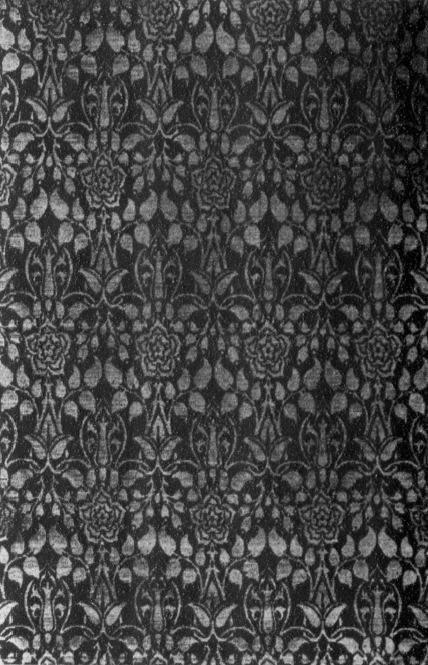
Gothic Rose Tapestry, in Silk and Aluminium,
designed by Edmund Hunter, woven at St Edmundsbury Weaving Works,
Art Journal, November 1906

Vineyard Poplin, from St Christopher's Church, designed by Edmund Hunter,
woven at St Edmundsbury Weaving Works,
Art Journal, November 1906
Superfrontal in Red and Black, designed by Edmund Hunter,
woven at St Edmundsbury Weaving Works, Art Journal, Noemvember 1906


Thursday, 29 December 2011

St Christopher's Church and the unidentified Woven Hanging

St. Christopher's Church has a beautiful large piece of weaving for which they did not have specific details as to the origin.  The extremely helpful and friendly ladies of the church showed it to me.  They kindly laid a part of it out over the church chairs which are six chairs wide in each aisle.  This is a large and very heavy piece of weaving.  It was probably hung on one side of the altar, and so there may have been two of these hangings but now the church has only one.

Woven hanging, St Christopher's Church, Haslemere

All of the church's furnishing are handmade and numerous items were made locally; this suggests that this piece was made in Haslemere.  Whilst the hanging is not recognizably Peasant Arts, the grape and vine motif was popular with the movement and so therefore it seemed plausible that this was made by the Haslemere Weaving Industry on Kings Road.   The birds hiding in the corn seemed to be out -of-character however.
Detail of woven hanging, St Christopher's Church,
Haslemere
Having then found the publication Recent Eccelesiastical Architecture (Nicholson, C., and Spooner, C.,  Technical Journals Ltd., London, c.1910) where Charles Spooner (the architect of St Christopher's) states "Another interesting feature of the interior is the curtain dividing the choir stalls...It is a very fine piece of colour, and was woven at Haslemere", this would seem to support the view that the hanging above was made in Haslemere.  Therefore making it either a product of the St Edmundsubry weavers, whom did not appear to produce such primitive styles, or be produced by the Haslemere Weaving Industry, one of the Peasant Arts industries.  However this was before I had found the article quoted in my previous post (Art Journal, February 1911), whereby it can be identified that the curtain being referred to is Luther Hooper's wool curtain.
Detail of woven hanging, St Christopher's Church,
Haslemere


By chance my recent discovering of the Art Journal  online at British Periodicals conclusively solved the mystery.  This is not a Peasant Arts woven hanging.  Reading R.E.D. Sketchley's article 'Haslemere Arts and Crafts' (Art Journal, November 1906) I saw this hanging illustrated!  It is titled as "Vineyard Poplin, designed by Edmund Hunter, woven at the St Edmundsbury Weaving Works" (ibid).  
Vineyard Poplin, designed by Edmund Hunter
from Art Journal, November 1906
As Sketchley reports "The weaving works of Mr. Luther Hooper and M. Edmund Hunter are not peasant-industries.  They demand in the work a higher executive skill than is necessary for the (latter)...In place of the primitive treadle-looms a Jacquard hand-loom is used...The St. Edmundsbury works had their beginning in Mr Hunter's experience as a designer for manufacture, a pattern-maker for materials and processes whose possibility is only theoretically apprehended...It had final issue in the starting of weaving works at Haslemere, with skilled weavers from Spitalfields to carry out their traditional craft, under the direct supervision of the designer....In the church textiles which are an important part of his industry, as in the more ornate designs for brocade, Mr Hunter's use of animal forms among the emblematic flowers points to inspiration from the great textiles of mediaeval Sicily, the wonderful webs whose romantic fantasy captures the sense of all those who respond to imagination in art.  But when he uses traditional forms, conventional or symbolic, the designer regards them for the purpose of the present, and in that spirit has produced in twentieth-century Haslemere some works of rare and quick beauty."

To have re-discovered the designer of this hanging, and that it was not the designer whom was expected feels quite remarkable.
Related Posts Plugin for WordPress, Blogger...