Showing posts with label Toys. Show all posts

Saturday, 11 June 2011

Ethel's Dolls

A final post for a while on toys!  It is poignant, that now after reading Ethel's book Gifts of St. Nicholas I am reminded of discovering a painting last December of one of the younger Hine sisters, by their elder sister Esther Hine, and that I had guessed that the painting was of Ethel.  The girl is playing with a doll.  Ethel would have been 8 years old at the time of the painting.


Esther Hine, Interior of Hine Family House, 1872
Some years after playing with her doll in the Hine family home, Ethel mused “Toys are not real to children.  The child loves her doll, will work for it, is proud of it, and yet knows all the while that it is a doll, and no baby.  To the cynic who says that at heart every woman is a rake I would assert that, at her heart’s heart, every woman is a Madonna, and capable of the devotion that asks for no visible or material return.  The truest motherhood is the spiritual motherhood, and the woman who perceives and adores the mystery of Incarnation is the true mother, though she may have no physical children to rise up and call her blessed…the child who understands this and lavishes a passion of tenderness on a rag doll in a tattered shawl, is a Madonna in bud.” (Gifts of St. Nicholas)


Whilst going through a whole 'box' of toys, Ethel goes on to describe "This next is a sacred thing - a doll.  In shape it is like a half ninepin cut vertically; it has black hair, a flushed complexion, blue eyes and a scarlet body; no more features, and no limbs at all! Ah, but this poor chip of wood, this irreducible minimum of human similitude, comes from a land where babes, wrapped in swaddling bands, have no visible limbs, and are little more than human tadpoles to look at, all heads and tails.

I have many dolls here, but there is one type which has no type in my little pantheon.  I refer to "the best doll," that object which is no real doll at all.  It is a monstrosity, the invention of governesses and nurses and other people who have shut the door on that other world of which we were speaking just now.  The true child could no more have a “best doll,” which came out in fine clothes on “treat days” and lived otherwise in a drawer in silver-papered retirement, than a mother could have a “best baby” and treat it in the same way.  No, these things with features flattened by use and affection, these limbless objects with benign faces in quaint dresses made by children’s hands, these are the real things which shared life and experience with their owners, and are frankly symbolic. Symbolic to the child, never real.  See, this gentle-faced, limbless, old wooden image, dressed in a fashion which reflects the mode of bygone decades, came home to her little owner, many years ago, in fullest possession of legs and arms.  But it was not be for long.  The little possessor retired to a corner and twisted off the limbs, and then, and then only, felt that she could love her.  The same hands that twisted off the excrescences sewed clothes for the remaining portion, and cherished it with tenderness for ever after.  There is more poetry than prose here, of a surety.

I rejoice to think of the child for whom this next doll was made; she must have had a truly rustic soul to appreciate this little wooden thing with arms akimbo, crimson skirt and ornate apron, and a large green wooden bonnet." (Blount, Ethel, Gifts of St. Nicholas)
All illustrations by Ethel Blount from
Gifts of St Nicholas: A Study of Toys


Saturday, 4 June 2011

Assorted Toys from the John Ruskin School

Ethel Blount describes a number of toys in Gifts of St Nicholas which must surely have been produced by the John Ruskin School.  Below are a number of them.


“This “warship” again, with sails of figured paper and a row of marines who stand at “attention” on her deck, has green wheels to move on instead of waves


...that Cracker, with scarlet coat and vast jaws which open and shut as you raise his tail-coat


...The Ark itself must have a wavy, red-tiled roof with dove and olive branch painted on it; Noah and family must be clad in robes of yellow, purple, and magenta, and the beasts be grey or brown as fancy suggests.  In toys shape is important but colour quite essential.


...this cousin of Dobbin’s, who has large blue and red spots to do duty for dappling on flank and neck


...Shall we go with this line of solemn geese, who quiver on their wires as they go, “schnattering,” before their little herd?  They have come from the land of “once upon a time,” and are traveling to the England of “some day.”  Shall we go with them?"

Friday, 3 June 2011

More of Ethel's Toys

Ethel Blount has so much to say on toys in Gifts of St. Nicholas and with many a toy underfoot myself I have found her writing on the subject fascinating.  It is such a shame that seemingly none of the toys made by the John Ruskin School (and which presumably Ethel is mostly describing in her writing and drawings) have survived:  


"The toys of early years must be coloured and trimmed.  A cricket ball has to look real, and so wears a sober murrey dress; but who would want a drab shuttlecock?  No, that child of earth and air is gay with a red velvet body a cincture of gold braid, and a glory of blue and white feathers..."Let’s pretend" covers all discrepancies; it is childhood’s own frmula to which every child responds…One is sometimes told of boy or girl who does not like fairy tales!  That cannot be.  Such a child would be a monster, an impossibility.  It is the mother or nurse who does not like fairy tales or does not know how to tell them aright.

Here is another cart, a musical one, which goes tink-a-tink, tink-a-tink as it is drawn along.  It is a cart to fill with one’s treasures, and give them a ride.  Here, Pussy, sitting on your squeaker, get in, and make room for this woolly lamb on rockers!  Here, Punch, with your grinning face, into that corner with you, and be polite to this well-brought-up, flat-packed, wooden lady with the rakish feather in her hat!  Now for the whip with the whistle in the handle – and then good Dobbin with black mane, and the red paper star blazing on his faithful breast, shall draw us half round the universe and all round the room."


Friday, 27 May 2011

A Toy Armoury

Ethel Blount (Gifts of St Nicholas: A Study of Toys) goes on to describe the toy weapons they make at the John Ruskin School.  I am not sure that much of this armoury would be allowed in toy shops today!   There are no more pictures of the armoury, so I've included some other toy pictures instead. 
Illustration of a toy bird on wheels
by Ethel Blount, 
Gifts of St Nicholas: A Study of Toys
"Our armoury has a great array of guns, from a tiny red cannon on yellow wheels up to the long deadly rifle with tin-foil-paper barrel.  Its wooden bullet, two inches in length, is tied to it firmly by due of string, while this pistol next to it shoots forth a captive cork with a terrible pop.  Swords and daggers are equally alarming and suggestive.  The blades are of fine, fine wood, pointed.  The black scabbards have, as a rule, patterns on them in yellow, and, as I well remember, just the same taste as the heads of Dutch dolls.
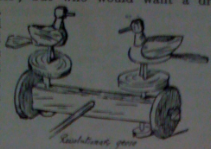
"Roundabout geese" from
Ethel Blount, Gifts of St Nicholas: A Study of Toys


Here is a cross-bow and bolt.  You set it, place the bolt and whiz - who knows what you may have hit?  And this bow, too, with its arrows that travel so lightly and deviously, this links you with Robin Hood and Little John, and all good men who ever lived under the greenwood tree.  It has a long ancestory.  The cloth-yard shafts of Senlac were among its forebears, and the arrow-heads of the Stone Age man."

Toys: the Baby Flapper

In Ethel Blount's book Gifts of St Nicholas: A Study of Toys there are numerous illustrations of toys that presumably represented the traditional toys made and sold by 'The John Ruskin School', in St George's Hall, Kings Road (situated where there is now St George's Flats).  I presume that the illustrations were by Ethel herself, as they were in her other book, The Story of the Homespun Web.  Ethel relays her thoughts on toys and the child imagination.  
A sword and baby flapper from Blount, Ethel
Gifts of St Nicholas: A Study of Toys

For example she writes that toys "are unreal and suggestive; furnished with them the child learns to live in this world of fact because they hold the door open into the other world, the world of imagination.  If that door were shut childhood would die, and the nursery would have a population of pigmy men and women.  So while the rich people not unfrequently give their babes diminutive facts to play with, the poor, the meek, who are to inherit the kingdom, have only symbols of earth and heaven to give theirs.  Whom shall we pity?"


Modern baby
castanet
Ethel talks about the baby 'flapper', which we would now call a 'baby castanet'.  Her playful narrative is quite captivating: "To us it is a poor joke, but the baby sees the point of it, and of its woven rattle too.  It and all true toys may be absurd, but their absurdity is above, not below reason.  Only untrue toys are below reason, such as large, bottle-nosed rag policemen, golliwogs and the like.  The true ones are either implements of sport, imitations of lovely or useful fact, or pure symbols of imagination, and, of course, the kinds overlap. The baby's rattle is his attempt at sport.  Would you see it nearer?  Then come with me among my toys, and come reverently, for you are entering the temple of the child's spirit."


In this, and other references, Ethel seems to be reflecting the values of today's Steiner Waldorf teaching.  

Related Posts Plugin for WordPress, Blogger...