Showing posts with label Handicraft. Show all posts

Saturday, 27 April 2019

Whitaker Wright and the Peasants

I recently read Ultimate Folly: The Rises and Falls of Whitaker Wright the World's Most Shameless Swindler (Macrory, Henry, Biteback Publishing, London, 2018) about Wright who lived at Lea Park, Witley.  Wright is famous for having an underwater glass ballroom in the lake and for committing suicide in the Royal Courts of Justice after being sentenced for fraud by cyanide pill.  Whilst Wright was local to the Haslemere Peasant Arts, I had not anticipated any overlap in their lives despite the Kings living at Sandhouse, literally down the road from Lea Park.  However, I was rather taken aback when I read this amongst the description of Wright's house, purchased in Witley in 1896.


"With money no object, he bought two large tracts of land to the west of the village, paying £150,000 for the Lea Park estate, which included the nineteenth-century manor house, and a further £100,000 for the adjacent South Park Farm estate.  This gave him a total of 9,000 acres, or a little over 14 square miles...the acquisition gave him ownership of two local beauty spots, Hindhead Common and the Devil's Punch Bowl...A London architect, Paxton Hood Watson, was contracted to turn the existing manor house into a pleasure palace, and royal warrant-holders George Jackson and Sons, who had carried out work at Buckingham Palace and Sandringham, were entrusted with the ornamental plasterwork.  Edwin Lutyens, who had been brought up in the neighbouring village of Thursley...was asked to design some lakeside buildings....

"...Under Paxton Watson's direction, two wings were added to the existing half-timbered manor house at the stupendous cost of £400,000.  The end of the new west wing was adorned with a vast conservatory, which alone cost £10,000 (around £1 million in today's money). ...At the far end of the house - a walk of several minutes along more than 500 ft of corridors adorned with hunting trophies, suits of armour and ceremonial swords -...a domed observatory...Between these two great embellishments were thirty-two bedrooms, eleven bathrooms, seventeen cloakrooms, seven receptions rooms and numerous courtyards paved in white marble and beautified  with Moorish arches." (Macrory, p.98)

The house and grounds were clearly "fit for an Oriental prince" which had been Wright's ambition.  It is incredible to think that such a sumptuous residence could exist in this quiet corner of Surrey.  As I read on, I was more amazed:

"The most sumptuous of the upstairs apartments was the so-called bridal suite, formed of two rooms, each 74ft long and 54ft wide...It had thirty windows, and was adorned with moulded ceilings, tall mirrors, oriental carpets and an array of antique Chinese and Japanese furniture.  The walls were hung with Japanese silk pictures patterned with foliage on an ivory background.  The dressing table, all 32 square feet of it, was covered with a tapestry embroidered with the words 'Love Maketh a Feast With Most or Least."(ibid.)

This distinctive phrase is on a tapestry held at the Haslemere Educational Museum, and was illustrated in The Craftsman (Stewart, Dick, 'Handicrafts of English peasants at Haslemere', pp.589-595, August 1907).  Reading the words in these versions the phrase is actually 'With Most of Least, Love Maketh a Feast'.  I have not seen a reference made to a 32 square foot version of this.

It seems extraordinary that someone who epitomised all that the Haslemere Peasants rallied against appeared to have in the heart of his home a piece of peasant tapestry that preached a very different message.  
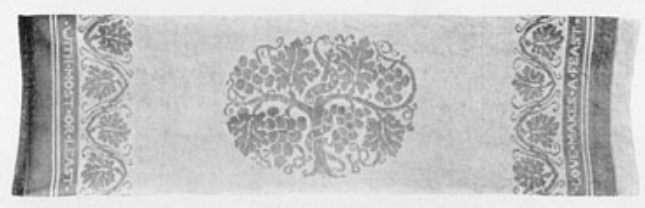
Peasant Tapestry, The Craftsman, August 1907


Thursday, 29 March 2018

Godfrey Blount, the Peasants & the Clarion Guild of Handicraft

In 1901 Blount is described as “urging the readers of the Clarion to pay more attention to Morris’s aesthethic theories.  In response, Julia Dawson helped to launch the Clarion Handicraft Guild ‘Joy in work, and hope in leisure’ became their motto” (Waters, Chris, British Socialists and the Politics of Popular Culture, 1884-1914, Manchester University Press, 1990, p173).

The Comrade, Volume 3, Number 3, p.57 

Godfrey Blount’s applique panel ‘The Spies’ which is held by the Victoria & Albert Museum, is recorded as being exhibited in 1903 at the second annual exhibition  of the Clarion Guild.  The Peasant Arts Society is listed as lending it's sympathetic support to the exhibition as one of the “best-known and most successful craftsmen and craftswomen in the country” (Spargo, John, ‘Socialism and the Arts and Crafts Movement’, The Comrade, Volume 3, Number 3, p.57 )  Edmund Hunter also exhibited a woven strip.   

from The Comrade, Volume 3, Number 3
The Clarion Guild of Handicraft encouraged ordinary people to undertake handicrafts "As most of the members are workingmen and women who have to earn their living during the day, they are only able to devote their scanty leisure to the pursuit of the their ideals in this direction.  They rent a room for guild purposes, holding meetings for discussion, classes, and the like, and doing their work there.  Thus they overcome a very serious obstacle which the lack of room in their homes presents.  They avoid making workshops of their already too cramped and overcrowded homes.  …Annual exhibitions are a feature of the new movement and a beautiful challenge shield of embossed colored leather, the work of a member of one of the Guilds, is awarded to the local Guild which makes the best exhibit.    At the second annual exhibition, held in the quaintly beautiful city of Chester, last Easter, Walter Crane, in a felicitous speech awarded it to the Liverpool Guild." (ibid.)


The Comrade, Volume 3, Number 3, p.57
As Spargo concluded "Why should we not have Socialist Handicraft Guilds in this country?  I see no reason why we should not have "Comrade Guilds" patterned after the "Clarion Guilds".  For we, too, are of the faith." (ibid.) 


Tuesday, 9 January 2018

Humanitarian craftswomen sought

The Herald of the Golden Age (August 1902) the following advert:

“A GENTLE CRAFT

Mr Godfrey Blount, of Haslemere, Surrey, is going to try an experiment in wood carving on a new style and he would like to hear from any humanitarian craftswomen who are interested in the subject.

The school that he suggests would be conducted on Fruitarian lines.

The more that we can combine practical arts and science and agriculture and industries of every sort with our humane ideals the better it will be for all, but new experiments must be well and carefully thought out.


Those who wish to learn the details of the scheme should direct to the promoters of this Peasant Art Industry."

The Herald of the Golden Age, August 1902

Saturday, 2 December 2017

Haslemere Educational Museum's Peasant Arts Christmas Card

Haslemere Educational Museum have made the bold step of printing a European Peasant Arts Collection Christmas card, of a slipware bowl from Germany.  It's a lovely festive card, which I hope they sell many of.  They are being sold in the museum shop at £4 for 10 cards.

Haslemere Museum Christmas Card, 2017
Slipware bowl from Germany

Haslemere Museum Christmas Card, 2017
Slipware bowl from Germany

Friday, 27 January 2017

St Christopher's Church at the V&A - Silk Damask


In the Summer I finally made it to the Clothworker's Centre, Blythe House at the Victoria & Albert Museum to see their Luther Hooper pieces.  I saw some pieces that were familiar to me from looking at them online, but it was fascinating to see them in real life.

For example, the portion of silk damask side curtain to the altar.  I had seen this picture first in the Art Journal, February 1911.   The damask in St Christopher's Church is described as "red-gold silk damask altar curtains", Spooner describes that the "altar curtains are of red silk damask with copper coloured silk lining, designed by Luther Hooper" (Nicholson, C., and Spooner, C., Recent Eccelesiastical Architecture, Technical Journals Ltd., London, c.1910).   Hooper describes that "their copper-coloured silk lining was woven by Messrs. Warner and Sons of London to the design of the writer" (Art Journal, ibid). 

Portion of Silk Damask, Side Curtain to Altar,
St. Christopher's, Haslemere
designed by Luther Hooper
from Art Journal, February 1911

The colouring of the silk damask held by the Victoria and Albert Museum is clearly not the same as in the Art Journal, but the design is.  

Silk damask by Luther Hooper,
Victoria & Albert Museum

Not only did they have the damask but they also had pattern papers of the same design.   As they were getting these textiles out for me, the V&A took photographs to add the photos to their collection records.  

Luther Hooper, pattern paper
Victoria & Albert Museum
Item T.13:2-1999, Online here

Luther Hooper, pattern paper
Victoria & Albert Museum

Sunday, 7 December 2014

Peasant Shopping - Part 4 - Sew Your Own Peasant Tapestry

In the Surrey Times (2 September 1899) they reported on the Haslemere Weaving Industry.  At this point we can see that there was no Peasant Shop in business in Haslemere.  In addition it appears that 'sew-your-own-kits' are not a new concept.  

The Tapestry Studio, Kings Road, Haslemere from
Art Journal, 1906

"The work is sold at the depot in London of the Peasant Arts Society, and is exhibited at the Arts and Crafts, Homes Arts, and other handcart exhibitions….Specimens of Peasant Tapestry will be on view at the Tapestry House daily where also orders can be received for finished work, or work prepared for those who desire to sew it themselves."

Thursday, 29 May 2014

Rainbow Secrets by Catherine A. Jones - Part 2 Heather & Bracken

Thank you to Sarah at the Weaving House for pointing out the Beryl Pooley painting of The Dye House that shows how the wool might have been hung out to dry on Foundry Meadow, as I was pondering in my previous post.  In the painting below perhaps they had been dyeing with heather to create the yellow and green and maybe dyeing with logwood for the blue.

A painting of The Dye House, Kings Road, Haslemere
by Beryl Pooley
reproduced courtesy of Sarah at the Weaving House

Another page of Rainbow Secrets outlines how to dye with heather and bracken, ingredients that were plentiful in Haslemere at the time I expect.

"Yellow, with Heather

The heather should be gathered just before it flowers.
Mordant.  For 1lb wool:
                 2 oz Alum
Mordant wool in usual way (for former recipes).
Dye.  3lb Heather tips

Put Heather into pan, cover it with wire netting to prevent it sticking to the wool.  Put in mordanted wool, fill up with water and boil for three-quarters of an hour.  This should give a good canary yellow.

The colour can be deepened by soaking in dye all night.

Wool previously dyed with Logwood, if steeped all night in hot solution of Heather, will turn green.


Jones, Catherine A., Rainbow Secrets, The Peasant Art Guild

Golden Yellow, with Heather

Mordant.  For 1lb wool:
                 1 oz. Bichromate of Potash
Dye.         3lb Heather

Process of dyeing same as for light yellow, but half an hour's boiling is sufficient.

Bracken

Deep cream or buff can be obtained by boiling 1 lb wool mordanted with 2oz Alum with 6lb young Bracken leaves.  (Same process as used for Heather).

Pale yellow green results from using 1 oz. Bichromate of Potash for mordant and same amount of Bracken."

Monday, 26 May 2014

Rainbow Secrets by Catherine A. Jones - Part 1: Madder

The Peasant Arts Guild published a booklet Rainbow Secrets by Catherine A. Jones, a copy of which is held by the Haslemere Educational Museum.  The booklet has the 17 Duke Street, Manchester Square address for the Peasant Arts Guild.

Jones, Catherine A., Rainbow Secrets, The Peasant Art Guild

In the 1901 census Catherine Jones is recorded as living in Honey Hill, Foundry Lane, the house which sits behind the Dye House on Kings Road.  Jones is described as a linen and cotton hand weaver.  In various other Peasant Arts documents, Jones is identified as the joint manager of the Weaving House, the joint curator of the Peasant Arts Museum and also the Treasurer of the New Crusade Toy Industry for Unemployed Women.

Rainbow Secrets is subtitled 'Recipes for colouring wool in simple and homely ways', It states on the front page:

"Before these secrets can be revealed the fleece must be cleansed and careful attention given to the following general instructions in Weaving, Mordanting and Dyeing Wool,

1. To succeed in producing bright colours soft water is a necessity.  In washing as well as dyeing hard water is altogether injurious to wool,

2. A handful of bran boiled in the water required for 1 lb of wool will have a good softening effect,

3. Wool must not be washed in very hot water,

4.  Wool must never be squeezed tightly when wet; heavy handling makes it matted and hard,

5. Mordanted wool must be kept covered until wanted for the dye bath, as light affects it unfavourable,

6. Wool must always be damp when put in to mordent or dye,

7. Some few dyes (Crotal is one) and mordants only can be safely used in iron pans; enamelled or zinc pans were safe for all,

8. The more care and attention that can be given to each process, the more satisfactory will be the result.

How to Wash Wool

1.  Pull the fleece apart.
2. Soak in cold water for 24 hours.
3. Make a good lather with soft soap or Lux in warm water.
4. Take a small portion of the fleece, shake it about well in the lather until all dirt and grease are removed.  Squeeze lightly and rinse thoroughly in clean warm water.
5. Repeat this process till all the fleece is washed.
6. Hang out to dry. Do not dry by a fire."

I wonder where the dye baths were situated?  And how big these would have been?  Where would the fleeces have been hung out to dry?  Maybe in what is now my garden, on the edge of the old Foundry Meadow.

The rest of the book seems to follow some similar content to the previous dye book and Skilbeck booklet I have posted on.   It begins with:

"How to Dye with Madder

Madder is the dried and ground-up root of a plant, Rubia linetorum, from which beautiful red and orange colours are obtained.

It requires a mordant to prepare the wool to receive the colour.  The mordanting must precede the dyeing.

Jones, Catherine A., Rainbow Secrets, The Peasant Art Guild


Mordanting.  For 1 lb, wool take 5 ozs. Alum and 1 oz Cream of Tartar.  Put Alum and Tartar into pan, not iron pan, and dissolve in enough water to cover wool well.

Take the clean, damp wool and put in the solution.
Heat and boil one hour(?) stirring occasionally.
Leave wool in mordant till cold (a day's soaking will not spoil it).
Lightly squeeze out and put away in linen bag (protected from light) for four or five days when it will be ready for dyeing.

Dyeing.  Bright red.

8ozs Madder for 1lb wool
Soak Madder overnight in water.
Next day put in pan (not iron pan), with enough water to cover wool.
Before the wool is put in this pan, heat the Madder to boiling-point, but do not boil it: boiling darkens the colour.

Put the mordanted wool into this pan of heated dye-liquid, and keep just below boiling-point for one hour.
Stir well with a stick in order that all parts of the wool may absorb the colour.
Remove from the dye, wash well in several changes of warm water, and hang out to dry.

Friday, 23 May 2014

Skilbeck Brothers Dry salters 1650 -1950


When I was looking through the Haslemere Educational Museum's dye books, one of the most astounding finds for me was some booklets of dyes and mordants by the Skilbeck Brothers.

The company advertised as being in operation since 1650.  Given that there is a book by Donovan Dawe's Skilbecks: drysalters, 1650-1950 held in the Printed Books Section of Guildhall Library, I deduce that Skilbecks went out of business in 1950.  Wikipedia says "According to a report published by the Bank of Korea on May 14, 2008 investigating 41 countries, there were 5,586 companies older than 200 years. From these 3,146 are located in Japan, 837 in Germany, 222 in the Netherlands and 196 in France."  Whilst not referring to the UK, the other statistic I could find on the subject of long running companies was from the BBC in 2012 "The average lifespan of a company listed in the S&P 500 index of leading US companies has decreased by more than 50 years in the last century, from 67 years in the 1920s to just 15 years today, according to Professor Richard Foster from Yale University."

Skilbeck Brothers catalogue 1924
Reproduced courtesy of Haslemere Educational Museum

The dyeing that occurred on Kings Road was recorded by Beryl Pooley (The Changing Face of Shottermill, Acorn Press, 1987) as "Children in those days could earn pocket money by collecting plants in woven shoulder bags and taking them to the dyeing house (opposite the weaving house) to be used to dye the skeins of thread for weaving…" but it would appear from the dye recipes and the presence of the Skilbeck booklets that there was a definite bought element to the dyeing ingredients.   Or perhaps the use of the Skilbeck booklets and the recipes that I have posted on here and here are remnants of a later time, in the 1920s when the Peasant Arts Society and the dyeing operations were potentially on a downward curve?  

Skilbeck Brothers booklet
Reproduced courtesy of Haslemere Educational Museum


One of the booklets begins with "This booklet is not to be taken as a textbook on Vegetable Dyeing, but our object in issuing it is to give such useful and historical information on the old dyes that should prove interesting to anyone already using or about to use them.

"In these days of modern inventions and improvements it is noteworthy that many of these dyes have been employed in very much the same way since man found the beauty of decoration and colour.

"It is our hope, therefore, that with such information as we can put before you, you will find an interest that is historical as well as artistic in one of the oldest of the crafts"


Skilbeck Brothers booklet
Reproduced courtesy of Haslemere Educational Museum
 Some of the explanations reflect ingredients in recipes reproduced in previous posts.  On Fustic, Skilbeck says "The wood of a tree grown in Brazil, Mexico and the West Indies.  One of the most important of all yellow colouring matters.  Extensively used in conjunction with Logwood for dyeing blacks and with other colouring matters for compound shades such as browns, olives, drabs, etc.  With Chrome mordants produces olive to yellow:

                                 shades

    • Alum - yellow
    • Iron -    dark olive
    • Copper - olive
    • Tin -       bright orange"


from a Skilbeck Brothers booklet
Reproduced courtesy of Haslemere Educational Museum

from a Skilbeck Brothers booklet
Reproduced courtesy of Haslemere Educational Museum

price list from a Skilbeck Brothers booklet
Reproduced courtesy of Haslemere Educational Museum

from a Skilbeck Brothers booklet
Reproduced courtesy of Haslemere Educational Museum


Related Posts Plugin for WordPress, Blogger...