Showing posts with label Victoria and Albert Museum. Show all posts

Saturday, 11 June 2011

The V&A's Peasant Industries panel c.1900

Having recently read Linda Parry's excellent Textiles of the Arts & Crafts Movement (Thames & Hudson, 2005), I have been looking at what the Victoria and Albert Museum (V&A) call The Spies, more closely.  Confusingly both of the V&A's Godfrey Blount pieces are called The Spies in various literature.


Blount, Godfrey, The Spies, c.1900 at the Victoria & Albert Museum


The V&A describe the panel as representing "a biblical story in which spies were sent to Canaan to look for the Promised Land and came back laden with huge grapes".  The lettering at the bottom of the panel reads "Confortamini et afferte nobis de fructibus terræ" which is taken from The Old Testament's Book of Numbers 13:21.  Having read the passage from the bible this sheds light onto the items in the panel.
Detail from Blount, Godfrey, The Spies, c.1900


The story describes God telling Moses to "send men to view the land of Chanaan, which I will give to the children of Israel, one of every tribe, of the rulers.  Moses did what the Lord had commanded, sending from the desert of Pharan, principal men...And Moses sent them to view that land of Chanaan, and said to them: Go you up by the south side. And when you shall come to the mountains, view the land, of what sort it is, and the people that are the inhabitants thereof, whether they be strong or weak: few in number or many:  The land itself, whether it be good or bad: what manner of cities, walled or without walls: The ground, fat or barren, woody or without trees. Be of good courage, and bring us of the fruits of the land." (New Advent Bible)
Detail from Blount, Godfrey, The Spies, c.1900


"Confortamini et afferte nobis de fructibus terræ" translates as "Be of good courage, and bring us the fruits of the land".


The story continues "Now it was the time when the firstripe grapes are fit to be eaten. And when they had gone up, they viewed the land from the desert of Sin, unto Rohob as you enter into Emath.  And they went up at the south side, and came to Hebron, where were Achiman and Sisai and Tholmai the sons of Enac. For Hebron was built seven years before Tanis the city of Egypt.  And forward as far as the torrent of the cluster of grapes, they cut off a branch with its cluster of grapes, which two men carried upon a lever. They took also of the pomegranates and of the figs of that place: Which was called Nehelescol, that is to say, the torrent of the cluster of grapes, because from thence the children of Israel had carried a cluster of grapes.  And they that went to spy out the land returned after forty days, having gone round all the country, and came to Moses and Aaron and to all the assembly of the children of Israel to the desert of Pharan, which is in Cades. And speaking to them and to all the multitude, they showed them the fruits of the land:  And they related and said: We came into the land to which you sent us, which in very deed flows with milk and honey as may be known by these fruits."
Detail from Blount, Godfrey, The Spies, c.1900


Hence we have an enormous cluster of grapes being carried by two men upon a lever.  The man on the left is carrying figs and on the right pomegranates.  There is no mention of the pineapple in this section of the bible!  It had sounded like this was one of a number of panels illustrating a story, if so, I can only think that the other panels would be illustrating different bible stories, as this panel seems to encapsulate the most illustrative element of Numbers 13.
Detail from Blount, Godfrey, The Spies, c.1900


Detail from Blount, Godfrey,
The Spies, c.1900
The V&A have told me that this panel "was given to the V&A as a gift from a Mrs. Joseph King in 1953", this would have been upon Joseph King's death.  Presumably the panel was a gift from King's brother and sister-in-law, Godfrey and Ethel Blount. Perhaps the panel was actually a gift to King's first wife, Maude Egerton King, Ethel's sister.  The date of the panel's creation was such an important time for the creation of the Peasant Arts movement with the Kings and the Blounts developing their workshops, at the height of the Arts and Craft interest in the Haslemere peasant workshops.  It is interesting that the panel was given to the V&A, and not to Haslemere Educational Museum with whom Joseph King had such a long relationship through his curatorship.

Thursday, 17 February 2011

Walter Crane's Peasant Blouse


Another connection between the Peasant Arts movement and Walter Crane, is Crane's interest in peasant clothing and embroidery.  Crane travelled Europe admiring peasant embroidery.  Peasant Arts members also travelled Europe gaining inspiration from peasant art, the most significant traveller being the Rev. Gerald Davies who amassed the objects that were donated as the Peasant Arts Museum.
Russian Peasant Embroidery illustration by Walter Crane from Crane, Walter, William Morris to Whistler G. Bell and Sons Limited, London, 1911) 


In his book William Morris to Whistler (Crane, G. Bell and Sons Limited, London, 1911) Crane writes “embroidery as an art of design may be considered from many different points of view – but none of these are more important than those of colour and its treatment.  It is indeed to colour that decorative needlework owes its chief charm, and in no direction is the influence of controlling taste more essential, and in its absence the most elaborate workmanship and technical accomplishment are apt to be wasted…


The Russian peasants have a form of frock or long blouse worn by young girls, which affords an instance of effective use of frank and bright colour upon a white ground.  The garment itself is of homespun linen.  It has a square opening for the neck, and is put on over the head, like a smock frock.  The sleeves are quite simple, full on the upper arm and narrowing to a band on the wrist.  The skirt, which falls straight from the shoulders, is decorated with a series of horizontal bands of pattern worked in cross-stitch, the principal colours being red and green, colours which always tell well upon white.  The square-cut opening at the neck and the cuffs are emphasized by embroidered pattern of similar kind but on a smaller scale.  The garment is ingeniously adapted to the growth of its wearer by adding extra rings of pattern to the skirt, and by enlarging a square piece let in at the arm-pits.”
From Crane, Walter, An Artist’s Reminscences, Macmillan Company, 1907

Upon discussing the use of colour in embroidery, he states “as a general principle, especially where many colours are employed, we are more likely to secure harmony if we choose reds, for instance, inclining to orange, blues inclining to green, yellows inclining to green or brown, blacks of a greenish or olive tone.  Perfectly frank and pure colours, however, may be harmonized, especially with the use of gold, though they are more difficult to deal with – unless one can command the natural, primitive instinct of the Hungarian, the Greek, or the Persian peasant.”
Embroidery detail of 1620s linen jacket, formerly of the Isham Collection at the V&A Museum

In Establishing Dress History (Taylor, Lou, Manchester University Press, 2004), it is described that “In 1900, Walter Crane much admired the quality of craft work in this collection (the Isham collection from Lamport Hall, Northamption, of twenty-seven rare examples of seventeenth-century dress and embroideries.  This included entire men’s suits of the 1675-1700 period and remains one of the great treasures of the Victoria and Albert Museum) and believed, all too optimistically as it turned out, that it ‘would make possible an instructive exhibition of costumes in the Museum’”.
Illustration by Walter Crane from Mrs Molesworth, The Tapestry Room: a Child's Romance,
MacMillan and Co., 1879

Describing a visit to Bohemia in 1890 (Crane, Walter, An Artist’s Reminscences, Macmillan Company, 1907), Crane writes “we made the acquaintance at Prague of M. Borowsky, the curator the Rudolphinum Museum…The most interesting things, however, to us were Bohemian peasant costumes, of which there was a fine collection.  Many of the peasant women’s head-dresses were wonderful, embroidered with gold and silver, and the dresses also embroidered.  The peasant women still embroider their own dresses and the national costume is kept up, and the peasants come out in their bravery, though it is true one heard that they did not like being stared at by the townsfolk.  They certainly seemed to belong to another race, and mad a striking contrast in the streets to the ordinary citizens in the unromantic garb of modern business and town life.   

Walter Crane by G.F. Watts, 1891
National Portrait Gallery
(G.F. Watts lived in Compton, a few miles from Haslemere)

Through the kindness of M. Borowsky, who induced a group of country folks in their costume to submit to the process, I was enabled to get a sketch of typical group who happened to be wandering through the Museum.  The lady was remarkable for her daring arrangement of colour.  A red kerchief, curiously folded, covered her head, showing a long plait of hair, to which was attached a big bow of pink ribbon edged with lace.  Her jacket was bright purple, elaborately embroidered and braided, and her skirt was a vivid print, in vertical stripes of red and yellow, bearing floral patterns.  Striped stockings (red and white) and (alas!) modern kid boots completed the costume.  She held a little rosary in her hands as she stood for me.”

In Carrara, Tuscany, on the same journey, Crane describes how he painted a model who was a fine “fine-looking peasant woman”, he explained that “the effect of the warm hite robe and deep-toned flesh against the blue in the full Italian sunlight was very striking and beautiful, and I made a study at the same time, which I afterwards exhibited at the R.W.S under the title of “Madonna of the Vineyards”.  I cannot trace this painting.

Museum of Applied Arts, Budapest

In 1900 Walter Crane took his touring exhibition to the Museum of Applied Arts, Budapest.  Crane recalls a speech that M. Radiscics, the Director of the Museum of Applied Arts, gave in his honour around 1900 “We must learn how the Hungarian peasant cloaks, flower-decorated trunks, dishes, cups, must be transformed into ornaments fit to embellish drawing-rooms, palaces, altars; we must learn how to transform into a creating power the aesthetical sense and artistic inclination of our people.  Should one man not be able to execute the task Walter Crane has finished alone, then the task must be shared among ten, among a hundred – and their activity will be blessed.”

Embroidery from Museum of Applied Arts, Budapest: "DĂ­sz nyeregtakarĂ³, rĂ©szlet, 1600 körĂ¼l"

 Crane writes that “I was able to get some sketches of the peasants in their costumes here, and very brilliant in colour they were.  They were quite willing to stand for one, too…An old woman was sitting at the small window busy at work on an elaborate piece of embroidery, which would take about six months to finish, she said.  These peasant embroideries were now being collected extensively by the rich people in the towns, and fine old pieces were becoming rate.  

Newer embroidery from Museum of Applied Arts, Budapest:
 "VörösruhĂ¡s nÅ‘, Rippl-RĂ³nai kĂ¡rpit, 1898"
Schools of embroidery were being established in the towns to teach the work which the peasantry had taught themselves, and of course, at every remove, the patterns became tamer.  It does not seem possible to transform unconscious spontaneous art into learned art, any more than it is possible for wild flowers to flourish in a formal garden.”  This places Crane potentially at odds with Godfrey Blount's prescribed works for the Peasant Arts movement.


Saturday, 12 February 2011

Walter Crane and the Peasants

I have found a number of different links between the artist and illustrator Walter Crane and members of the Peasant Arts movement.  Following on from the recent posts, let us start with the Healthy & Artistic Dress Union connection. 

Walter Crane, self portrait, 1885, The Whitworth Art Gallery

Godfrey and Ethel Blount were on the General Committee of the Healthy & Artistic Dress Union from 1904 until at least the end of 1906.  At the same time, Walter Crane was a Vice President of the Union, one of ten Vice Presidents in position at any one time!  The Dress Review cover and promotional leaflets (see my earlier post The Corset) were designed by Crane.  Mrs G.F. Watts, wife of the painter and sculptor, from Compton, a few miles away from Haslemere, was another Vice President.   Mrs Walter Crane was also involved in the Union.


According to the Victoria & Albert Museum, Crane designed some gowns for ‘aesthetic dress’ in Aglaia the journal of the Healthy and Artistic Dress Union, preceding The Dress Review.  However the only writing I have come across that demonstrates what the Healthy & Artistic Dress Union meant to Walter Crane, is the reproduction of his letter in The Dress Review in October 1905.  Unable to attend a Union committee meeting at the studio of Mr Frank S. Ogilvie, the painter, who was on the Executive Committee of the Union, Crane sent a letter saying:

Wychombe Studios, London, where painter Frank S. Ogilvie had a studio in 1905,
site of the Healthy & Artistic Dress Union meeting
“As I am not able to attend the gathering of the members of the Healthy and Artistic Dress Union at your studio and I am invited to write a line on the objects of the society, may I say that of course I sympathise with the movement towards a better ideal of beauty and health in costume.  At the same time the subject is full of difficulties.  I feel that dress is, as it always has been, the result of slow evolution, and is dependent upon the form and system of society under which it takes shape.  There is a great variety in modern dress, and the tendency seems to be to specialize it more and more in adapting garments to every kind of employment and sport.  Now I think that such specialised costumes must always have a certain character of their own, though they may be by no means always beautiful.  Convenience and utility seem to be the principal objects with their makers and wearer…while we have many convenient costumes carefully adapted to various pursuits, both for men and women, they are shorn of romance and, though not altogether without their picturesque aspects, they are prosaic, as a rule.

detail from the cover of The Dress Review, 1904, illustration by Walter Crane

The present mode in ladies’ dress often attains great elegance, and there are abundant beautiful materials, charming in colour and texture, to be had, needing only taste to utilize them with delightful effect.  Whether it is part of the great modern movement for freedom on the part of women that they should have now so much more liberty in the matter of dress than men, I won’t ventute to say, but  certainly a lady of taste  seems to have far more range in the matter of costume, choice of material, change and variety than a man at the present day, and men seem much more slaves to convention—at least in formal and commercial life.
Summer by Walter Crane 1895

In underclothing a great pitch of excellence has been undoubtedly reached and much science and invention devoted to its manufacture, but few, I fear, would venture to follow the suggestion of Du Maurier, who once in Punch represented an evening party attired in these beautifully fitting garments, chiefly, if I remember rightly, as a substitute for the modern evening dress of gentlemen.

Climate comes in as an important factor in deciding a form of dress, and social habits and custom also.

Tea gown made by Liberty's c. 1894, similar to
Walter Crane's designs,
at The Victoria and Albert Museum 
Conscious efforts towards beauty are not always successful, and any sudden reversion to past types is apt to have a theatrical suggestion about it, so that, in the main, dress reformers have a rather narrow field to move in, and it becomes a question often of simplification, or small changes, or grafts upon existing types rather than any frank departure on new lines.  Until great social and economic changes take place in the constitution of society, therefore, I do not think we can expect any very general adoption of new types of dress except special adaptations to practical purposes of new inventions, such as the motor, which has brought in quite a distinct type of costume, both for men and women, not without a certain weird picturesqueness sometimes (the linen coats of the chauffeurs are quite a good feature).

When again in a community of workers, people are proud of their employments, and consider it an honourable distinction to wear the distinctive dress appropriate to their work, we might again have great variety and beauty, bringing character and colour into common life.

Yours very truly
                      Walter Crane"


Mrs Walter Crane (Mary Frances), c.1886 wearing a high waisted, uncorseted dress from The Victoria & Albert Museum

In July 1906 The Dress Review has a quite amusing recount of a Healthy and Artistic Dress Union meeting, “presided over by Mistress Walter Crane, who wore a charming costume of olive-brown velvet…A few highly appreciated words were spoken by Mistress Crane, who emphatically condemned tight-lacing, though she admitted she now liked a little support herself.”

Friday, 12 November 2010

Architecture: Francis W. Troup

F.W.Troup, RIBA


Troup (1859-1941) was an architect born in Huntly, Grampian.  He is relevant to the Peasant Arts story as he built the main Peasant Arts buildings in Haslemere and the residence of Joseph and Maude Egerton King.  Troup was the second son of Robert Troup and Margaret MacDonald.  In 1877 he was articled to the Glasgow architects practice of Campbell Douglas and Sellers, where noteworthy architects such as J.M.Brydon, W.Flockhart and J.M.MacLaren had worked (Budgen, West Surrey Architecture, 2002).  It was here that in 1860 J.J.Stevenson had worked, who Troup joined in London. 
Sandhouse, Wormley by F.W. Troup 1910.  Built for Joseph King and Maude Egerton King

J.J. Stevenson was a founder member of the Society for the Protection of Ancient Buildings (SPAB) in 1877 which was formed by William Morris, Philip Webb and other notable members of the Pre-Raphelite brotherhood.  J.J. Stevenson set out SPAB's ideals in 'Architectural Restoration: its principals and practice', published in that 1877, the publication was controversial and Stevenson was somewhat belatedly admitted to FRIBA in 1879.  With his initial training complete, in 1883 Troup moved to London and joined Stevenson’s office.  This office had a reputation for being the “stepping stone to London” for young Scottish architects.

Leadwork, St John's College, Oxford renovated by F.W.Troup 1889

In 1885 Troup was awarded a Silver Medal by the Royal Academy for a series of measured drawings of the north porch of St Pauls Cathedral, the drawings were printed in The Builder.  In 1889, then as Clerk of Works at Stevenson’s office, Troup was responsible for the renovation of the fabric of St John’s College, Oxford, this followed thirty foot of library parapet falling into the quad.  At a recent conference (The Traditional Paint Forum 2009), St Johns College, Oxford was described as having the finest examples of decorative leadwork in Britain.  
F.W.Troup drawings of St. John's College, Oxford


F.W.Troup drawings of St. John's College, Oxford
Weaver (English Leadwork: Its Art and History, Donhead Publishing, 1909) says that St John’s College, Oxford, has “four (leadwork) features of which are the elaborate painting and gilding of the lead.  The royal arms and the arms of Archibishop Laud are blazoned in their proper colours, and the turreted face of the heads and the funnel outlets are painted black and white in chevron bands and in many other delightful patterns.  We are indebted to the painstaking care of Mr. F.W. Troup for the restoration of this colour work.  Mr Troup’s measured drawings of the heads are reproduced below” - above actually(!).


This book also includes a photograph of a rain-water pipehead designed by Troup and made by a ‘Mr Dodds’.  Later on Weaver states that “the art of modern leadwork owes a great debt to Mr. F. W. Troup and his own designs always strikes the right note.”  From the references to Troup in this literature, it is clear that Troup was giving inspirational lectures on leadwork to students at the London County Council Central School of Arts and Crafts.
designed by F.W.Troup
Sundial designed by F.W.Troup


In 1889 Troup gained RIBA Associateship status.  In 1898 he worked with fellow Scot, Robert Lorimer, know for his arts and crafts buildings who went onto create large Scots Baronial country houses including Ardkinglas Estate on Loch Fyne in 1906.  Troup supervised the construction of Lorimer's Whinfold in Hascombe (currently for sale in 2010 for £8million).  Robert Falconer MacDonald was also working in the Stevenson office at this time, and is reported to have been designing houses in Haslemere and Hambledon.  In 1899 the building of St. George’s Wood, Haslemere began, the last home of George MacDonald, this was designed by Robert Falconer MacDonald, George’s son.  Greville MacDonald said in his letter to his father dated 8th December 1899 “Yesterday I signed the contract for the building of St. George’s Wood.  For that, an’ it please you, will be your English home for all your earthly time.  Bob’s plans were quite perfect, I think; and there you will easily gather together in your arms - you and Mother – all your children.  It should be a lovely home, set amongst huge beech-trees.  The country is still gloriously lovely.  How exquisite in the Winter months may-be brown and purple all a-glitter in cold sunlight.” (MacDonald, Reminiscences of a Specialist, 1932).
Whinfold, Hascombe


Whinfold, Hascombe


Joseph King and his wife Maude Egerton King had moved to Upper Birtley, Grayswood (near Haslemere) in 1894.  In 1897 they were joined by Maude’s sister Ethel Blount and her husband Godfrey Blount who resided in Foundry Lane.   It would appear that Joseph King owned Foundry Cottage (where the Blounts were residing in 1901) on Foundry Lane, at that time one of the only houses on the land and the surrounding land which was called Foundry Meadow, now part of Kings Road.  It was about this time that Joseph King engaged Troup to design what would become Greenbushes and Honey Hill on Foundry Lane and the Weaving House, the Old Studio and the Dye House on Kings Road.  Joseph King became Troup’s most inspired patron, and the one for whom he built his best country house, Sandhouse in Wormley.   King probably made his connection with Troup through his cousin Greville MacDonald, who was the elder brother of Robert Falconer MacDonald who worked in the Stevenson offices with Troup.
Gilbert Bayes, Bust of F.W.Troup, Artworkers Guild, London , 1932

In 1898 Troup’s diary mentions five separate schemes he was working on for King: “Copse Cottages, the new laundry, the Weavers house and the studio and workroom” (Jackson, F.W.Troup: Architect 1859-1941, Building Centre Trust, 1985).   Jackson tried to identify the cottages and laundry in Wormley, and failed to identify the other buildings, however it is evident that these are the buildings on Foundry Lane and Foundry Meadow.  For example, the Surrey Times (2nd September 1899) reports that “The new weaving house in Foundry Meadow, to be opened on Tuesday next, consists of two large work-rooms, etc., and is a picturesque building, designed by Mr. Frank Troup.  Eleven looms can be comfortably worked in it…”  Greenbushes exhibits Troup’s trademark leadwork around the front entrance. 

Workman's Cottage, F.W.Troup, The Studio, 1901
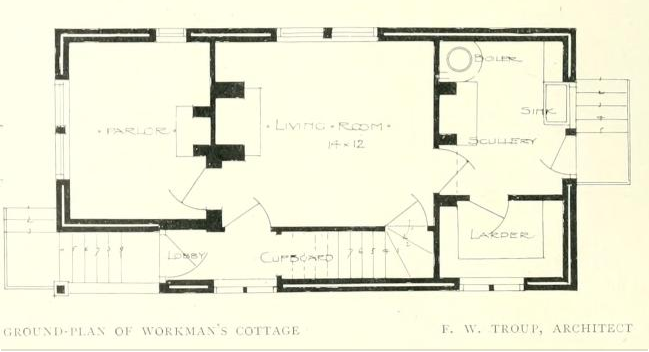
Ground floor plan, Workman's Cottage, F.W.Troup
First floor plan, Workman's Cottage, F..W.Troup
End Elevation of Workman's Cottage, F.W.Troup


The Studio (vol 20-22, 1901) published an article on workman’s cottages and reported that “The interesting single cottage for a workman, designed and carried out under the direction of Mr. W. Troup, shows an arrangement on both ground and first floor which within certain limits it would be difficult to better.  Built on the side of a hill, a portion of the basement is naturally utilized for a tool-house, coal-shed, etc.  The plan of both ground and first floor is very simple.  A living-room entered from a little porch or lobby, that is reached by a flight of external steps, with a parlour on the right and scullery on the left, is followed by an almost similar arrangement of rooms on the first floor, approached by a staircase leading off the living-room; a passage or landing at the head of the stairs connects the three rooms, the bedroom on the left running over the porch and steps.  The rood is covered with brown tiles, the first floor hung with bright red.  The shutters to the windows are required, and not placed there merely for ornament, as the tenant will occasionally lock up and leave the house.  Up to the first floor the walls are of brick.”  The gradient that the cottage is built on, as shown in the lower picture above, could easily be the steep gradient of Kings Road and Foundry Lane.

Entrance hall with Godfrey Blount's frieze
Inside Sandhouse, F.W.Troup


Sandhouse in Sandhills, Wormley was Troup’s showcase house.  Budgen describes it as “quite remarkable…the elevations are built up in polychrome brickwork, the blue headers forming a pronounced diaper pattern which must have been extremely bright when first built” and links this pattern to Ruskin’s ‘structural polychromy’.  Weaver’s “enthusiastic review of the house for Country Life says that ‘in Sandhouse we have a home where the crafts have had full sway, and its architectural atmosphere befits its owners’”.  Whilst this is no doubt his genuine opinion, it is interesting that from reading Weaver’s Leadwork: Its Art and History it is evident that Weaver and Troup were close friends.   Descriptions of the house include “the dining room (where) the ceiling timbers were left rough-sawn and simply white-washed.  Godfrey Blount’s plaster frieze in the hall was a later addition which detracts from the simplicity of the space.  The craftwork evident throughout the building comes to a climax in the leadwork – in the stable clock, the dormer above the porch and ornate rainwater heads and down pipes.  Next to the tall central bay on the garden front is a rainwater head based on those Troup restored at St John’s, Oxford.” (Jackson, ibid).
The Arts Connected with Building (front page), 1909

Troup contributed the chapters ‘External Leadwork’ and ‘The Influence of Material on Design in Woodwork’ to The Arts connected with Building (B.T.Batsford, 1909).  This is a collection of lectures on craftsmanship and design delivered at Carpenters Hall, London Wall to the Worshipful Company of Carpenters.  This book also contained chapters from notable arts and craftsmen of the time, a number of which are linked to the Haslemere area: Romney Green (working in Foundry Meadow in the early 1900s), C. F. A. Voysey (who built houses on the Hogs Back, Guildford and Norney all nearby to Haslemere), M. H. Baille Scott (who lived in Haslemere in 1912, two houses in Grayshott have been identified as being built during his residence), Guy Dawber (who became president of RIBA) and Charles Spooner (who built St Christopher’s Church in Haslemere, and also lectured at the Central School of Arts and Crafts).
Jackson, F.W.Troup, Architect 1859-1941, Building Centre Trust, 1985

Thereafter Troup's practice was reasonably prosperous, punctuated by a small number of really large jobs, Thistlegate House, Charmouth, Dorset in 1911, Blackfriars House, New Bridge Street, London in 1913, Cambridge University Press in 1920 and from 1921 the Bank of England where his scheme was superseded by that of Sir Herbert Baker, and he was a supervising architect to the Bank of England and prepared designs for the rebuilding of the Threadneedle site. In that year he entered into a partnership with Harold Rooksby Steele which lasted until February 1941 when Troup retired.
Wardrobe designed by Francis Troup, made by Edward Barnsley, 1931, Victoria & Albert Museum

Troup was an Arts and Crafts man throughout his life with a particular interest in leadwork and was an excellent craftsman himself.   He designed the walnut and mahogany and cedar lined wardrobe above for his own home.   The V&A state "It is thought that the sliding handles which conceal keyholes on the cupboard doors were probably his idea. However, the form and materials of the wardrobe are characteristic of Barnsley’s work. In particular, the framed-panel construction of the wardrobe doors and sides, the use of light-coloured wood, and the inclusion of graduated drawers (increasing in depth towards the bottom) are all features commonly found in Barnsley's work".   
Troup, Art Workers Guild, 6 Queen Square, London: The Great Hall, 1918


Troup was an active member of the Art Workers Guild, being Chairman in 1905-6, and Honorary Secretary 1907-19.  Troup became Master of the Art Workers Guild in 1923.  He was Honorary Secretary of the SPAB in 1940.  
Cheap cottage, Letchworth, F.W.Troup, 1905
F.W.Troup, 1905
F.W.Troup, 1905

There is a Francis William Troup archive at the RIBA Library (Royal Institute of British Architects) which has pictures of some of Troup’s commissions.  It contains many pictures of Sandhouse, Witley, but also a house similar in style to the Dye House on Kings Road: 124 Wilbury Road, Letchworth.  It is noted that this house ‘This three bedroom timber cottage was the winner of a competition for a timber cottage costing not more than (£)150 entered at the 1905 Cheap Cottage Exhibition at Letchworth. It has since been altered and extended’.   Budgen notes that “from about 1905, Troup designed a series of very small cottages that he felt offered an inexpensive means of obtaining a roof over ones head.  His first design, for E.P.King, was built in Downton, near Lymington Hampshire, and made use of the latest materials to produce a five-roomed two-storey cottage at the amazing price of £148.  The timber framed building was set on a concrete raft and faced with rendered steel laths and roofed with tiles.” (Budgen, ibid).  It seems clear that this building was designed for Ernest Powell King, Joseph's King's younger brother by two years who died in 1905.  Ernest Powell lived at Wainsford House in Lymington, and in the 1901 census Edwin Lutyens is visiting.


The Letchworth house above which was designed later that year included a walk-in larder and earth closet, and came with weather boarded walls.  His design was used as a basis for a series of designs by others to provide the market with a means of inexpensive housing for the working classes.  If the Dye House was built before these houses, which is certainly what Troup’s other buildings on Foundry Meadow in 1899 who suggest, then it would appear that Troup’s Dye House design was amended to create Troup’s new cheap cottage design.


Sources:
V&A museum-  
http://collections.vam.ac.uk/item/O131467/wardrobe/?print=1
Dictionary of Scottish Architects-  
http://www.scottisharchitects.org.uk/
Francis Troup RIBA archive- 
http://ribapix.com/index.php?a=wordsearch&s=gallery&w=francis+troup&go.x=0&go.y=0&go=Go


Related Posts Plugin for WordPress, Blogger...