Showing posts with label Weaving Houses. Show all posts

Thursday, 5 June 2014

Peasant Houses for Sale

All of the Haslemere Peasant Arts houses and buildings that still exist today are now homes.  I don't have photographs of them in the present day on this website as I think it would be an invasion of privacy.  However at the moment, two of these houses are for sale and photographs of them are on the internet.  For a rather unpeasant-like sum you could purchase and relive the Peasant Arts days.

The Tapestry Studio/ The Peasant Arts Museum, Kings Road
Designed by Francis Troup.  Used as the Tapestry Studio c.1899-1912 when it then became the Peasant Arts Museum (1912-c.1925).

The Old Studio, Kings Road, Haslemere
for sale at Hamptons


The Tapestry Studio, Kings Road, Haslemere from Art Journal, 1906

Peasant Arts Museum, Haslemere (postcard)
reproduced courtesy of Haslemere Educational Museum

Lower Birtley
The first house that Joseph King and Maude Egerton King lived in after leaving London, they lived there c.1894-1901.  Work was exhibited at the 1896 Arts and Crafts Exhibition Society under the title "Lower Birtley Hand Weaving Industry' as detailed in my post here.  Lower Birtley consists of a number of houses grouped together.  I am not sure whether the house currently for sale is the same 'Lower Bertley' painted by Maude Egerton King's brother, William Egerton Hine, but I think it is.  It is probably the biggest house at Lower Birtley, and given the size of Sandhouse, their later house in Witley, it would appear that the Kings liked large houses.

Lower Birtley Farm, Grayswood
currently for sale with Hamptons

A House at Lower Bertley, Witley by William Egerton Hine, 1895


Lower Birtley Farm, Grayswood
currently for sale with Hamptons
extract of Arts and Crafts Exhibition Catalogue, 1896
showing the Lower Birtley Hand-weaving Industry

Saturday, 10 May 2014

Renovating the Three Shuttles Weaving Sign

An old original Haslemere weaving sign was re-discovered in the archives at Haslemere Educational Museum a few years ago.  It was restored and is now on display in the Haslemere Peasant Arts section of the museum.   The sign was renovated by Ian Clark Restoration, who share some photographs of the sign before and after restoration on their website here.  They state "ICR was contacted to conserve this rare survivor of wrought iron folk art.  The ironwork and remains of the original decorative scheme was sensitively cleaned, consolidated and conserved."

Restoration of Haslemere's Three Shuttles sign


Restored Three Shuttles sign on display at
Haslemere Educational Museum
There are a number of old photographs which show the sign outside of various Haslemere buildings.  I wonder which building the restored sign once hung outside?

Weaving Sign, Kings Road from Winter and Collyer, Around Haslemere and Hindhead in Old Photographs, Alan Sutton Publishing, 1991
The Three Shuttles sign hanging outside
The Weaving House, Kings Road, Haslemere
c.1900
The Three Shuttles sign
hanging somewhere in Haslemere?
reproduced courtesy of Haslemere Educational Museum

The Three Shuttles sign hanging outside
Peasant Arts Society Shop,
No. 1, The Pavement, High Street
c.1900

Friday, 29 March 2013

The Influence of Handicraft upon the Workers, 1918 Part 1

On February 28 1918, Ethel Blount and her sister Maude E. King presented a paper at the Peasant Arts Fellowship meeting in Caxton Hall titled Our Experience of the Influence of Handicraft upon the Workers (The Peasant Arts Fellowship Papers No. 10, Vineyard Press, Messrs. J. M. Dent & Sons, London, 1918).  Their speech began:

"If this paper, the subject of which is one of deepest human interest, proves but a dry cataloguish affair, we would ask you to consider the difficulty of compressing the experience of many years into fifteen minutes...

Interior of Weaving House, Kings Road, Haslemere
from Pooley, B., The Changing Face of Shottermill,
Acorn Press, Haslemere, 1987

"A girl coming into the Weaving Home or the Workroom quickly interested in the work, becomes very proud of her growing skills, and, while gradually mastering a beautiful craft, is also acquiring the splendid patience of the good hand-worker.  If, at the outset, she is less refined than her companions in the workroom we find she soon grows noticeably gentler in her ways and simpler in her dressing.  During the careful processes of craft, much grinding and polishing of human jewels would seem to take place, for many unsuspected treasurers are brought to light.

"For example, one embroideress develops the power of drawing minute reductions of large designs, very fluently and charmingly; another reads a paper in defence of hand - opposed to machine-work at her chapel guild; another gets a loom of her own into her cottage in order to weave the clothes of her dearly loved little son, as well as her own best wear; another stays behind and works overtime to make her own wedding-dress.  "Of course, I couldn't be married in anything but a hand-woven dress." she said, when we expressed our pleasure about it.  Yet another develops a rare sense of colour.  Of some more than usually beautiful arrangement of colour we sometimes learn from her fellow-workers - she is too modest to tell us herself - that she has tried therein to symbolise something of herself or of them, her friends, or the mood of a sweet grey morning or the splendour of autumn woods.

The Tapestry Studio, Kings Road, Haslemere
from 
Art Journal, 1906
"A philanthropic millionaire was watching her weaving in a public exhibition not long since, and - mechanical speed and high pay embodying for him the highest good! - he remarked compassionately, "Well, God help the poor creatures that have to make a living at that!".  "Yes, He does!"" said the little weaver surprised at his simplicity.  Doubtless, had the philanthropist lingered long enough to discuss the matter, he would have asked, "Well, allowing that it is worth a girl's while to weave for you, how is she when busy in her own home ever to find time to weave for herself?"

The Weaving House, Kings Road, Haslemere c. 1902
from The Craftsman, January 1902

"Let this story answer him.  In a remote Sussex village lives a young girl, trained in our Industries, whose father is a small farmer, baker, and miller.   The mother is a very busy woman, constantly called into the little shop, and this, the eldest daughter, must help with the cooking and home-work generally.  And yet on Christmas Day last she gave her father a suit-length of tweed which she had spun, dyed, and woven herself.  Now she is making a dress for her mother, and clothes for brothers and sisters are to follow.  All this, be it remembered, is done in the spare times of a busy, dutiful life, where, as a Highland woman once said to us, "she has a great deal to do all amongst everything, indeed!"  She has a little workroom, where with loom and wheel and the fleeces from her father's South Down sheep, she sits and works wonders like any little princess in a fairy tale!  And here she holds a weekly spinning circle for her sisters and friends, doing her utmost to kindle other flames from her own bright torch.  We are all very proud, I am sure, to acknowledge her as one of the first members of our Peasant Arts Fellowship."

Blount, E. and King, M.E.,
Our Influence of the Influence of Handicraft upon the Workers,
Peasant Arts Fellowship Papers, No. 10,
Vineyard Press, Dent & Sons, 1918
 

Friday, 3 August 2012

Weaving and Rambling


I have recently acquired an old guidebook to Haslemere, The Rambler's Guide to Haslemere, Hindhead and District, and I was interested to see the advert on the opening front leaf of the book for the Haslemere Weaving Industry.  There is no publication date, but it is probably c. 1928, judging from the statement that "this industry, established over 30 years" and the reference to "the late Mrs Maude E. King" later in the book.

Haslemere Weaving Industry advert from
The Rambler's Guide to Haslemere, Hindhead and District
Under a section titled 'Industry' the guidebook reads "The idea of keeping alive traditional handicrafts in the vital industries and bringing art into the service, not only of luxury, but of every-day life has inspired various activities and workers in Haslemere for more than a generation.  It still persists in various ways,notably in the Hand-weaving Industries of the Peasant Arts Society in King's Road and of the Inval Weavers.  The former, founded in 1895 by the late Mrs Maude E. King, specializes in linen and cotton textiles; the latter are famed for their woollen materials, especially dress fabrics; but each can show a wide range and variety of beautiful weavings, which visitors can always see being woven and worked up".

Haslemere map from
The Rambler's Guide to Haslemere, Hindhead and District
with the Weaving Industry labelled as number 10
from
The Rambler's Guide to Haslemere, Hindhead and District


Haslemere adverts from
The Rambler's Guide to Haslemere, Hindhead and District

Electricity advert from
The Rambler's Guide to Haslemere, Hindhead and District


Thursday, 26 July 2012

Al Fresco Working on Kings Road

Now that we have a respite from the wet and the cold, let us imagine what the workers at the Weaving House, Tapestry Studio and St Cross would have been doing on such warm days.

Weaving a hand-knotted rug on a tapestry loom at Haslemere,
Art Workers Quarterly, 1902
(from Haslam, Arts and Crafts Carpets, David Black, London, 1991)
The steep slope behind this weaver is a sure sign of the location on Kings Road or Foundry Meadow.  The large tree trunk glimpsed in the top left hand corner, and the small section of building behind have not been positively identified!  This is the only photograph I have seen showing hand-knotted rug-making in practice at Haslemere.  The design being executed is likely to be by Godfrey Blount.  I have found no evidence of known Haslemere carpets in existence today.

Group of spinners and weavers at St Cross, Haslemere,
The Studio, XLIII, 1908
(from Haslam, Arts and Crafts Carpets, David Black, London, 1991)
The ladies in the photograph above can be clearly seen to be working on applique 'peasant tapestry'.  I have another version of this photograph on my blog, but this one taken from Haslam's excellent Arts and Crafts Carpets (David Black, London, 1991) is infinitely clearer, and shows the detail of what they were working on.  On the left we have a recognisable spinning wheel, on the right, the lady in white is working on what seems to be an different type of spinning wheel, one I have not seen before.  *Amended in September 2012*  The "different type of spinning wheel" is actually a hank winder – not a spinning wheel. The yarn is made into a hank on a hank winder before being dyed, then put back on the hank winder before being wound onto a cone or bobbin.  Sitting in the middle of the photograph may be Ethel Blount, she certainly has the hair colour but it is difficult to be certain.

I wonder if the photographs were staged outdoors or whether they depict routine outdoor working?


'Miss Flora Synge at her spinning wheel at Kings Road, Haslemere in 1917'
from  Janaway, John,  Surrey: A Photographic Record 1850-1920, Countryside Books, 1984

Finally we have a photograph which I have posted before of Flora Synge.  When I originally posted this photograph I had a comment made by her great niece saying that Flora "used to take her spinning wheel on the train when she returned home to Liverpool to visit her parents" which gives an interesting insight to how attached some of the members of the Peasant Arts movement were to their craft.  Behind Flora may be a wall of perhaps a building with some sort of climbing plant against it, or a very steep slope cut into the bank.


Saturday, 7 May 2011

A historic walk down Kings Road

I thought I'd put all the old pictures I've found of Kings Road, Haslemere in some order:


Entrance to Kings Road c.1910 - the railway house on the right was demolished in 1960
 from Winter and Collyer, Around Haslemere and Hindhead in Old Photographs,
Alan Sutton Publishing, 1991


'The Hazels' on Kings Road c. 1910 this was a private temperance hotel, restaurant and confectioners


from Winter and Collyer, Around Haslemere and Hindhead in Old Photographs,
Alan Sutton Publishing, 1991


W.H.Stoneman & Co c.1920 - next to the Three Counties Church viewed from near Fosters Bridge.  This builders merchant business began around 1908.  There is a petrol pump outside (underneath the 'lavatories' sign).  Aruna House now stands on this site.


from Winter and Collyer, Around Haslemere and Hindhead in Old Photographs,
Alan Sutton Publishing, 1991

The Kings procession 1903 - "A great procession followed King Edward VII along Kings Road towards Midhurst in 1903...the building on the left was the gasworks.  The Haslemere Gas Company was incorporated in 1868 with a nominal capital of £1,500...in 1917 the Limited Company was dissolved and re-incorporated as The Haslemere and District Gas Company, becoming part of the Southern Gas Board following nationalization on 1 May 1949.  The old gas works was closed in 1972 when the area was converted to natural gas"  (Winter and Collyer, Around Haslemere and Hindhead in Old Photographs, 
Alan Sutton Publishing, 1991).  

Note there appears to be a man sitting on the window at the gas company, you can see his feet and hands.  All that remains of the building now is  a brick wall between the terraced houses pictured and some new houses, Holmwood Heights.  After the King's visit, Foundry Road or Gasworks Road as it was named became Kings Road.

Somewhere along the road, the King would be reported to say "that he had always heard of Haslemere as a pretty town, but now was disappointed"(Rolston, Haslemere 1850-1950, Phillimore, 1964).

from Winter, Tim, Around Haslemere,
Tempus Publishing Limited, 2002


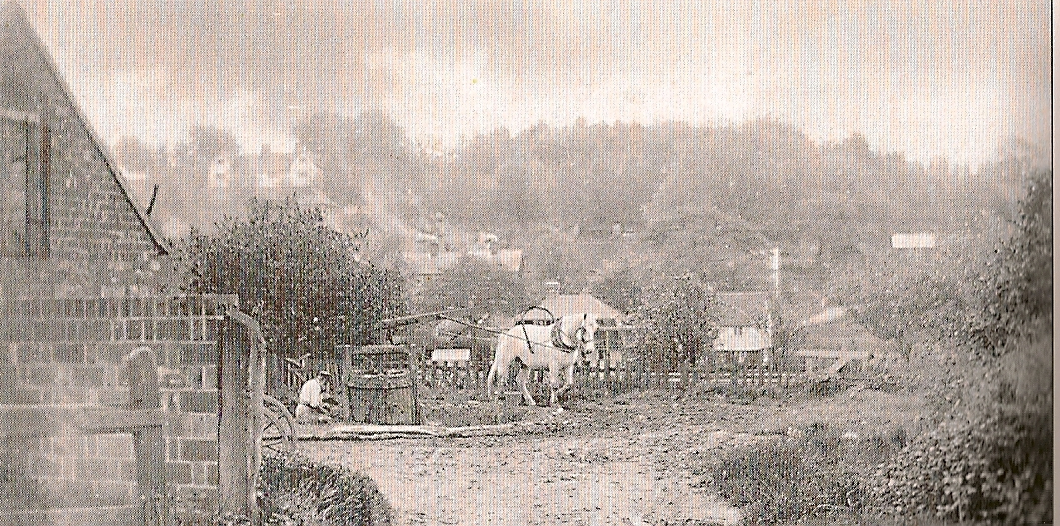
The Weaving House and the old Studio - behind the horse in the background.  The side of the hill between Kings Road and Longdene is much less developed, some buildings can be vaguely seen in the Foundry Meadow area.  In the foreground is a horse-powered pug mill, puddling clay before it was used to make bricks and tiles.  The site of the photograph is what is now the Wey Hill car park.  Wey Hill was previously known as Clay Hill, where there were brickworks.
Looking across to Kings Road from Weyhill c. 1910
from Winter, Tim, 
Around Haslemere, Tempus Publishing Limited, 2002


The Weaving House - an old postcard.  The weaving sign of three shuttles can clearly be seen by the gate.  A notice on the gate is headed ‘Haslemere Weaving’.  The entrance door is on the first floor of the building, demonstrating the steep slope that the house is built on.  The entrance ‘bridge’ crosses a small stream referred to historically as ‘Brittons Water’. 

from Winter, Tim, Around Haslemere,
Tempus Publishing Limited, 2002


The tree in the middle of the road - another view of the Weaving House where Foundry Lane joins Kings Road.  The girl is holding a hoop.
from The Craftsmen, January 1902

The Old Studio c.1982 - with the Weaving House in the background

from T.D.L. Thomas, 'Rustic Renaissance: Arts and Crafts in Haslemere', Country Life, April 15, 1982

Spinning wool outside in Kings Road - Miss Flora Synge at her spinning wheel in 1917, it is not clear where exactly on Kings Road she is.  Flora's great niece has told us that Flora "was a second cousin of Joseph King and a very independent lady, a graduate of Cambridge and wove all her life, settling in Hawkshead in later life.  She used to take her spinning wheel on the train when she returned home to Liverpool to visit her parents".

from  Janaway, John,  Surrey: A Photographic Record 1850-1920,
Countryside Books, 1984

The Dye House

The side of the Dye House from
Pooley, 
The Changing Face of Shottermill, Acorn Press, 1987
Back view of part of The Dye House 1933 - this picture by Francis Frith was taken from Longdene and appears to show the side of Honey Hill, Foundry Lane, on the left.  The small black hut in the middle of the photograph, with the 'white' window, was attached to the rest of the Dye House, which is hidden by trees, when it was turned into a residence around 1950.  The building on the left of the black hut must be St George's Hall, site of the Country Church, where St George's Flats now stand.  The view across to St Christopher's Green is now blighted by the Weyhill car park.  The buildings which flank the current car park can be seen on the right.  The photograph has two horizontal lines: the train line nearest the Dye House hut and then the main road through Weyhill.

from the Francis Frith archive
The Foundry 1876 - from which Foundry Road (now Kings Road) originally got it's name.  Winter (Around Haslemere, Tempus Publishing Limited, 2002) states: "Puttick's Mill Foundry was almost certainly between the present-day Foundry Lane and Kings Road, about where St George's Hall and the old Dye House were later built on the south side of the road.  In August 1876 there was still the 'shadow' of a water wheel visible on the wall behind the short ladder (in the picture below).  The 1886 Ordnance Survey map showed two buildings, close together, with a leat carrying water to them from the stream near Foster's Bridge.  From the mill wheel the water ran away into the stream towards Sicklemill.  This is now piped below the small side road of houses, built where the first Haslemere sewage works was sited, and, later, a builder's yard used by Riley & Whishaw.  The approach road to the foundry led from the old coach road that crossed the railway line through a crossing gate at the corner of St Christophers Road.  At this time there was not continuous road through on the present line of Kings Road.  It is not known when the foundry closed but William Puttick was listed at the Lion Foundry, Shottermill, perhaps near Lion Green, in a later nineteenth-century trades directory."

from Winter, Tim, Around Haslemere,
Tempus Publishing Limited, 2002

Saturday, 15 January 2011

An Ideal Setting for a Village Industry

The location of the Peasant Arts movement in Haslemere, is best understood through the judgements of their peers.  An article by Mary Schenck Woolson in The Craftsman (‘Revival of English handicrafts: the Haslemere industries’, January 1902) provides an excellent overview.  Woolson was President of the Women’s Educational and Industrial Union, and Director of the Manhattan Trade School for Girls.

The Weaving House, Kings Road c.1902 - note the girl is holding a hoop and the tree in the middle of the road! - from The Craftsmen, January 1902

She describes the location of the Peasant Arts in Haslemere as “A more ideal setting for a village industry, whose avowed purpose is to make good hand-made materials under ideal conditions, could scarcely be found.  In the southwest corner of Surrey, in a deep valley between wooded cliffs, is the little town which straggles picturesquely in winding lanes like wandering vines up the steep slopes.  In summer, in the near distance, the eye traverses stretches yellow with gorse and broom, and purple with heather up to the hig, dark ridge of Hindhead.

The Devil's Punchbowl, Hindhead c.1900 from Trotter, The Hilltop Writers, The Book Guild, 2003

On the top stands high against the sky the cross which marks Gibbet Hill, where the execution of a sailor’s murderers once took place.  Below the cross is a romantic lonely hollow called the Devil’s Punch Bowl, around whose rim Smike and Nicholas Nickleby, as they were going from London to Portsmouth to seek their fortune, walked and read the description of the sailor’s murder.

Tennysons Lane c. 1897 from Wright, Hindhead or the English Switzerland, 1898

The atmosphere of Haslemere is artistic and literary.  Here George Eliot lived on the Shotter Mill way, Tyndall built high on Hindhead and Tennyson’s home looked out on the Blackdown.  Artists and writers still gather here. 
Hindhead Crossroads c.1900 from Winter, Tim, Around Haslemere, The History Press Limited,  2004

The village keeps its mediaeval appearance.  The cottages of the people are low, with slanting tiled roofs.  These ancient hand-made tiles of many varieties are well known to architects and antiquarians.  The lanes are often so steep that the sidewalk is only on one side, while a high, abrupt cliff rises on the other.

Haslemere High Street c.1894 from Trotter, The Hilltop Writers, The Book Guild, 2003

The sidewalk gradually ascends above the road way and the cottages open on the sidewalk with a steep staircase descending to the road.  This gives a curious and picturesque effect to the old stone cottages and the half timber houses with their overhanging stories.  The workers in the Haslemere Industries live in such homes as these, surrounded from birth with charming nature and the simple artistic handwork of man. 

Entrance to Kings Road from the station from Winter and Collyer, Around Haslemere and Hindhead in Old Photographs, Alan Sutton Publishing, 1991

….From the railroad station deep in the valley to the quaint little Weaving House modern factory conditions seem to struggle for a footing.  Foundry Road is a paved street with workshops, stores and working men’s houses crowding one another together.  When the road begins to rise out of the narrow valley, the Weaving House and its close companion, the Tapestry House, stand as if to utter a protest and block the way against the farther march of ugliness.  Beyond them the open valley stretches, the wooded hills show winding paths and the birds sing in meadow and copse. 

In front of the Industries the road slopes upward, so that the buildings are partly below the level.  Bridges swing across from the road to the second stories, and steps lead down to the ground floors of the buildings.

Inside The Weaving House, Kings Road from The Craftsmen, January 1902

From the open windows of the Weaving House the steady click and thud of the looms and the whirr of the wheels are heard by passers-by.  A sign hangs over the gate on the bridge bearing the name: “Haslemere Weaving Industry,” and below, a placard bids visitors welcome.”

“The cheerful, healthful workrooms, the mediaeval furniture of chests, presses, wheels, reels and looms, the bold fine colouring of the stuffs, the white aproned village workers, and the wide stretching meadows and steep hills of fair Surrey, as seen through the windows are a pleasant picture of labour under ideal conditions.”
'Miss Flora Synge at her spinning wheel at Kings Road, Haslemere in 1917' from  Janaway, John,  Surrey: A Photographic Record 1850-1920, Countryside Books, 1984

Whilst the picture in Janaway is annotated as Flora Synge, there is no such name recorded in the 1911 census. 

Sunday, 5 December 2010

The Weaving Houses, Kings Road c.1900

There are 3 houses on Kings Road that were part of the Peasant Arts movement, all of these were designed by Francis Troup. Troup is cited as having recorded in his 1898 diary that he was working on designing 5 buildings for Joseph King: “Copse Cottages, the new laundry, the Weavers house and the studio and workroom” (Jackson, F.W.Troup: Architect 1859-1941, Building Centre Trust, 1985).  Of these The Weaving House and The Studio are the most easy to identify in Kings Road.

The Weaving House, Kings Road, Haslemere from The Studio, Volume 43, February 1908
The Weaving House
This appears to have been used by the Kings for the Haslemere Weaving Industry. The Surrey Times (2nd September 1899) reports that “The new weaving house in Foundry Meadow, to be opened on Tuesday next, consists of two large work-rooms, etc., and is a picturesque building, designed by Mr. Frank Troup.  Eleven looms can be comfortably worked in it…” 
The Weaving House, Kings Road, Haslemere from Winter and Collyer, Around Haslemere and Hindhead in Old Photographs, Alan Sutton Publishing, 1991

Pictures of the outside of this house are the most widely circulated of the Haslemere weaving houses.  In the above a weaving sign of three shuttles can clearly be seen by the gate.  A notice on the gate is headed ‘Haslemere Weaving’.  The entrance door is on the first floor of the building, demonstrating the steep slope that the house is built on.  The entrance ‘bridge’ crosses a small stream referred to historically as ‘Brittons Water’.  This stream was used by the iron foundry in Foundry Meadow which was first started around the late 1500s.


The Tapestry Studio, Kings Road, Haslemere from Art Journal, 1906
The Old Studio
This appears to have been used by the Blounts as the Tapestry Studio. Part of The Old Studio building can be seen to the left of the Weaving House in the picture above. The ladies making hand tufted carpets and appliqué tapestry are probably inside this building in the picture above.

Later, in 1912, the Peasant Arts Museum is said to have moved to 38-40 Kings Road, which is The Weaving House and The Old Studio.  However it is not clear how the collection was accommodated within these working business premises, unless the workplaces transferred to other buildings such as St Cross in Weydown Road where the Blounts opened the School of Handicraft in 1902.
The Weaving House and The Old Studio (behind the horse), Winter, Around Haslemere, Tempus Publishing Limited, 2002

The photograph above shows The Weaving House and The Old Studio in the background.  The side of the hill is much less developed, some buildings can be vaguely seen in the Foundry Meadow area.  In the foreground is a horse-powered pug mill, puddling clay before it was used to make bricks and tiles.  The site of the photograph is what is now the Wey Hill car park.  Wey Hill was previously known as Clay Hill, where there were brickworks.

Side of the Dye House (Pooley, The Changing Face of Shottermill, Acorn Press, 1987)

The Dye House
Perhaps this house is referred to in Troup’s 1898 diary as the ‘new laundry’.  Originally the land of the Dye House bordered both Foundry Meadow (now Kings Road), and also Foundry Lane, the entrance being just next to the entrance to Honey Hill on Foundry Lane.  At some point the building was used as a Dye House and there is a recollection of the Dye House in operation, recorded by Beryl Pooley.  Referring to the Peasant Arts movement, “Some pottery and curtain materials were made to blend in with each other.  People could order their individual colour schemes.  Children in those days could earn pocket money by collecting plants in woven shoulder bags and taking them to the dyeing house (opposite the weaving house) to be used to dye the skeins of thread for weaving…Tablecloths from those days which have been used for over 50 years, are still bright in colour and need little or no ironing.  The colour mixes and designed are most attractive.  There seem to be very few examples of this work left today, which is a great pity.  Hangings were thrown away as people would get fed up with them – the fabrics seemed to last for ever.” (Pooley, The Changing Face of Shottermill, Acorn Press, 1987). 

Later weaving moved to the Dye House, as the illustration of the old weavers sign below demonstrates.  This is the sign that can be seen outside The Weaving House in the photograph above.
Weaving Sign, Kings Road from Winter and Collyer, Around Haslemere and Hindhead in Old Photographs, Alan Sutton Publishing, 1991

All of these houses are now residential homes.
Related Posts Plugin for WordPress, Blogger...