Showing posts with label arthur romney green. Show all posts

Sunday, 4 March 2018

The Independent Labour Party, Harold Monro & Arthur Romney Green

There were numerous lectures at the Independent Labour Party, Haslemere on Kings Road, held in Arthur Romney Green's workshop and showroom.  In addition to the Ramsay MacDonald and Joe St  Loe Strachey, chaired by the Lord Bishop of Dorking written in a previous post here, there is a record of Harold Monro giving a lecture.

Monro (1879-1932), see Wikipedia here, was a poet and proprietor of the Poetry Bookshop, an influential shop that sold and published poetry in Bloomsbury, London.

Harold Monro and the Poetry Workshop (Grant, Joy, University of California Press, 1967)

In Harold Monro and the Poetry Workshop (Grant, Joy, University of California Press, 1967), online here, Grant writes:


"Through James Guthrie, Monro came into contact with the community of weavers, embroiderers and other craftsmen who inhabited Haslemere at that time, and were trying to conduct their lives on the principles of Ruskin and Morris.  He was especially friendly with Romney Green, the designer and carpenter, who made superb tables and chairs out of ponderous baulks of oak, and who later supplied the furniture for the Poetry Bookshop.  ‘This rugged, fiery, somewhat intractable yet generous creature’, Arundel del Re writes, ‘loathed all forms of aestheticism and literary cant.’  He believed, with Whitman, that art was for the regeneration of man.

"There were thus kindred souls of progressive outlook near at hand, and we hear of Monro going to Haslemere to lecture to the Independent Labour Party there.  

"…The interior (of the Poetry Bookshop) fulfilled the promise of the outside.  Monro called in Romney Green to provide bookshelves, tables and settles in his characteristic style – massive but finely proportioned furniture hewn from great baulks of oak.  It added to the homeliness of the  shop and with its flavour of rus in urbe suggested the character of the proprietor."

Friday, 1 December 2017

Decorative Arts Society - Arthur Romney Green

The new issue of the Decorative Arts Society Journal, no. 41 (2017) includes a marvellous article by Neil Hyman on Arthur Romney Green 'Obscure Geometry: patterns of influence in the work of Arthur Romney Green'.

I have had the pleasure of meeting Neil during a number of his visits to Haslemere when he was researching this article including photographing the Arthur Romney Green (ARG) panelled oak chest at St Bartholomew's Church and visiting ARG's old workshop.  Both of which are shown in the article.  Neil believes that ARG's time in Haslemere had a significant influence on ARG's artistic style, which is a fascinating insight.

The Decorative Arts Society Journal 41, 2017

There is more on the Society and Journal, which is published annually, on their website here.


Thursday, 25 August 2016

On the Arthur Romney Green Christchurch trail - the Priory

Walking out of the former 3 Bridge Street, Arthur Romney Green's (ARG's) workshop, showroom and home, it is only a few metres further down the road until you reach the bridge over the River Avon.  ARG "loved the symmetry of the five arches...describing the built arch 'so gracefully suspended over empty space by virtue of its weight' as one of the miracles of human art like the sailing shop and the bicycle."  (Life to the Lees, Elkin, Susan, 1998).

View of Prezzo, formerly 3 Bridge Street, from the bridge,
Christchurch, Dorset

The bridge over the Avon by 3 Bridge Street,
Christchurch, Dorset

From the bridge you can see the Priory, the remains of the great tower of Christchurch castle and the Norman House.  You have to walk past the Norman House and castle remains to access the Priory.  English Heritage describes these buildings as "the mound top-keep or great tower was a part of a large Norman castle that once dominated the town...Nearby is the 12th century riverside chamber block known as the Norman House, one of the few remaining examples of domestic Norman architecture in England.  Built in about 1160, it provided grand and comfortable living quarters for the lord of Christchurch.  The tall circular Norman chimney is a particularly rare survival."
The view from the bridge across to The Priory,
Bridge Street, Christchurch
The Priory approach is particularly impressive.  Following the description of the ARG furniture in the  Priory by Elkin (ibid.) we were aiming to go to the Lady Chapel at the far end of the building, but we stopped to see the main features on the way.


It was a good job we did because the nice surprise was that the ARG chairs are now placed at the front of the nave altar and choir stalls.   Elkin describes only one of these chairs in her book, the one of the right below, although surely they are both by ARG and are displayed opposite each other as "a magnificent ceremonial chair".  The geometric designs on the chairs are classic ARG, the mirror of the cut-out pattern on the left opposite the other carved with various Christian symbols.


the nave altar at Christopher Priory,
the ARG chairs facing each other either side of the altar

There 'IHS' at the top, and a star of David below it on the right, with another star of David below on the far left.  A circle with a cross in them are I think referred to as a 'solar cross' or 'sun cross'.  The fourth row of symbols are two 'X's.  The final row, that can be seen at least from standing as a visitor, seems to have the initials HRX.  These symbols by the side of the altar which has the large altar cloth symbol of the triquetra reflects an interest I suspect by someone at the Priory in Christian symbolism.  Wikipedia explains the triquetra as representing "the Holy Trinity: the Father, Son, and Holy Spirit. The unbroken circle represents eternity. The interwoven nature of the symbol denotes the indivisibility and equality of the Holy Trinity. It symbolizes that the Holy Trinity is three beings of power, honor, and glory but is indivisibly one God".

ARG ceremonial chair engraved with Christian symbols,
Christchurch Priory
Walking further into the Priory, looking at the High Altar, we saw the two prayer desks opposite each other.  Elgin describes these as "Instead of a ball shape for the hand to grasp at the top of each upright, there is a truncated octahedron.  It's a mathematical idea typical of Green.  He had the same shape carved in stone for eventual use on his tombstone." (ibid.)


High altar, with ARG prayer tables opposite each other
Christchurch Priory

The positioning of the chairs at the nave altar and the prayer desks at the High Altar is all the more remarkable for the story behind ARG's commission, as Elkin explains "She and Green were still unmarried, and although most of their London friends had been away of their position, they saw little need to advertise it on arrival in Christchurch.  When, however, the Vicar of Christchurch, Canon Gay, decided to order some pieces for the Lady Chapel in the Priory, Green thought that he had better 'own up'.  And his honesty cost him the order.  It wasn't until several years later, when Gay's successor saw Green's and Bertha's dog, Fanny, clad in a cosy jacket, that he observed that a man who looked after his dog so well couldn't be all bad, so he placed an order." (ibid.)

ARG prayer table, high altar
Christchurch Priory

ARG prayer table, high altar
Christchurch Priory

ARG prayer table, high altar
Christchurch Priory
I could not find the moveable altar rails which Elkin had also identified as at the Priory, but I think that the chairs and prayer tables are more distinctive and pleasing to the eye.  ARG's memorial stone is shown on the Dorset Life website here.


Head of ARG's memorial stone,
Christchurch

Saturday, 20 August 2016

On the Arthur Romney Green Christchurch trail - the workshop, showroom & home

Today we decided to visit Christchurch to see the Arthur Romney Green pieces and his old workshop.  I have been meaning to visit for about 5 years since I was given Life to the Lees (Elkin, Susan, 1998), 'A Biography of Arthur Romney Green'.   It took less than 90 minutes to reach from Haslemere which was a pleasant surprise and made me wonder why we had not visited earlier.

First we passed what had been 3 Bridge Street, Arthur Romney Green's (ARG's) workshop, showroom and home.  The road still retains some character, being a single lane as it passes the former 3 Bridge Street.  Although I had seen this on the map, visiting in person I was surprised by the proximity of the Avon Bridge and the nearby Priory.

25 Bridge Street, Christchurch

It is always fascinating to see an old photograph and the present day view.  Whilst the outside has inevitably changed a great deal in the passing of almost century, the bow windows lend a constancy to the scene.  Elkin describes the scene "An old Victorian grocer's shop, 25 Bridge Street, lay a few yards over Avon Bridge heading out of Christchurch in what was then Hampshire.  With the river so close and the muddy creek running down to the Avon along the back of Green's and other properties, he effectively had river access just as he had had at Strand-on-the-Green.  Although the creek sometimes dried out in summer, for much of the time Green could, and did, swim or sail away from the bottom of his own garden into the Avon, past its confluence with the Stour and towards the open sea." (ibid)


25 Bridge Street, Christchurch, August 2016

A. Romney Green's workshop
3 Bridge Street, Christchurch
c.1930?

The blue plaque to the right of the right hand window is almost hidden behind an olive tree.  It reads "ROMNEY GREEN 1872-1945 Master craftsman lived and worked here from 1920 until his death", "donated by friends".  It is interesting that the plaque dispenses with his first name 'Arthur'.

Blue plaque to Arthur Romney Green,
Bridge Street, Christchurch
When we returned to Prezzo for lunch and went inside the building it was fascinating to see what a comparatively small space was occupied by the workshop and showroom.  According to Elkin "The right-hand shop, nearest to the Avon Bridge, was the low-ceilinged workshop containing several work benches.  Green liked the fact that passers-by could look through the window and watch the work in progress, some of which went on in here and some in the converted apple loft outside.  Finished items were displayed in the left-hand shop which served for many years as Green's showroom.  Some of the heavy work was done in a converted tool shed which the men called the 'article' shed because is contained such 'articles' as a circular saw and a band saw, driven b hand or foot power." (ibid.)  Now, the right-hand side of the shop is almost totally taken up by the serving bar for the restaurant.  

interior of 25 Bridge Street, Christchurch
A. Romney Green's old workshop and showroom

Sitting in-between courses, with a treasured swan feather found from the riverbank, it was nice to read the poem that Elkin prints of ARG describing "his beloved home":

"And so we come by an old-world street, through a modern thoroughfare
To our river-skirted home in the poignant borderland;
Past whose ancient front the tide of painted automobiles flows in fury,
But whose posterns open to the cry of the redshank,
Hyacinths beneath the mulberry
And the music of the flight of the swan."

When we used the toilet, it was interesting to note that "When Green took over 25 Bridge Street its only sanitation was what Graham Castle describes as a 'midden' in the garden.  Inevitably, it wasn't long before Green was compelled by the authorities to install adequate sanitation for all the people using the premises.  This he did - with a certain amount of wryly amused resentment.  Two flush lavatories, one for the men and another for Green and Bertha, were put in the back of the building.  Only Green, lover of 'rural hygiene' and forward-thinking environmentalist would then pen a sonnet 'To a Water Closet'." (ibid)  The sonnet contains the lines:

"The sea, once blue, now foul'd, on which our sway
Declines, our fields, once green on which it grew"

There are only two toilets downstairs at the property still, could these be in the same place?  Hopefully we used the right one.  ARG's sonnet reminds me of the tale of the Blount's gardener from Therese Le Chard "When taking tea on the lawn, the stately old gardener could occasionally be seen passing slowly by with two buckets of human excrement on their way to remoter fertilizing duty.  In nature nothing was held to be unpleasant or unclean." (A Sailor Hat in the House of the Lord, George Allen & Unwin, London, 1967).

We looked outside in the garden for the mulberry tree which of course was not to be found.  There was no prospect of a swim from the end of the garden.  Elkin explains "Today the geography is different.  Bridge Street was re-numbered in the 1930s and the French restaurant which now occupies Green's former premises, and sports a commemorative blue plaque, is No.3.  The back garden behind it is quite short, the creek has been filled in and there are newish buildings behind.  Christchurch Marina, built after Green's time, has altered the views."  

The French restaurant of 1998 has now become Prezzo, an Italian restaurant.  The kitchen occupies the back of the building, maybe in an area that had been used as a tool shed!  The restaurant takes over the adjoining buildings also, maybe what was 2 further properties in ARG's time.  Whilst the non-solid wood furniture in the restaurant would not have met with ARG's approval, it is interesting that the old showroom and workshop are still full of chairs and tables almost a century on from ARG's time.  And the food was very nice.

No prospect of swimming to the sea from 25 Bridge Street
in August 2016

The back of 25 Bridge Street, Christchurch


Tuesday, 12 November 2013

Arthur Romney Green's table at Charterhouse

Following up on a reference in Arthur Romney Green's biography to a refectory table at Charterhouse School, down the road from Haslemere in Godalming, I have heard back from them, and it is not good news.  

Susan Elkin reported that Romney Green did some work for Charterhouse "including the big oak refectory table for Hodgsonites House, a photograph of which he used for advertizing purposes"  (Elkin, Susan, (Life to the LeesCromwell Press, 1998).  I thought that this work was probably made for Charterhouse following the Master of Charterhouse, Gerald Davies', interest in arts and crafts, and the sale of his peasant arts collection to the Peasant Arts Guild in 1908.   Sadly I have not found the advert that is being referred to.
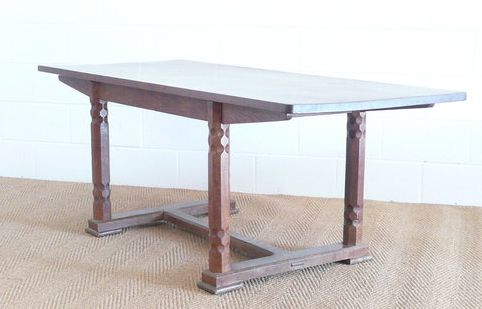
Arthur Romney Green oak refectory table
with octagonal leg detailing
for sale at antiques-atlas
Charterhouse's archivist has told me "We have not been able to identify Green’s big oak refectory table in Hodgonsites House.  Although all the Houses still have long refectory tables in their dining halls (as you will be able to see if you just look through the windows of the Central Dining Rooms on the left as you drive into Charterhouse) I am not aware of any particularly decorative Arts and Crafts tables and the Housemaster of Hodgsonites tells me that there is nothing of that nature in the boarding house. 

"The boarding Houses were still run as private enterprises by each Housemaster in the Edwardian era, so the table would presumably have been commissioned by T E Page, a distinguished Classics teacher, who taught at Charterhouse from 1875 to 1910 and was Housemaster of Hodgsonites between 1881 and 1910.  The original Hodgsonites boarding house was demolished in the 1970s, together with six other Houses, and they were relocated in new buildings, so it is possible that the table was lost at that point. "

Interestingly, there is an Arthur Romney Green "oak refectory dining table" currently for sale on antiques-atlas: "A Cotswold School oak refectory dining table designed and made by Arthur Romney Green c.1920. Signed "ARG". Octagonal legs with scalloped decoration. Pegged construction throughout."  I wonder if the refectory table at Charterhouse looked like this.  The table legs have a very similar design to the altar chair in St Christopher's Church, Haslemere which my photographs do not do justice to.

Arthur Romney Green altar chair,
with octagonal leg detailing
St Christopher's Church, Haslemere

I have also found this photograph of Standen, the National Trust Arts and Crafts property, which says that the table at the bottom of the staircase is by Arthur Romney Green, the legs here do look like they have similar octagonal shaping.  As I discovered from looking at previous Arthur Romney Green items for sale in another post, Arthur Grogan, the curator of Standen collected Arthur Romney Green works.

Arthur Romney Green oval table at Standen, National Trust house
from ViewPictures 

Tuesday, 1 October 2013

Arthur Romney Green on wood, Foundry Meadow, 1907

When I was looking through the National Art Library's special collection on Arthur Romney Green, I came across this letter written on his headed note paper from 1907.


Arthur Romney Green Letterhead, Foundry Meadow, Haslemere,
24 July 1907
I have struggled to read it word for word, I believe it says:

"Dear Sir

Would you kindly supply me as soon as possible with lantern slides prepared from the negatives whose numbers on your catalogues I give below.  These slides you prepared a few months ago to illustrate a lecture given by me to the Society of Arts.  These numbers are:

18261 - XVI ? Oak Door
19305 XVII  -   -     Door
22041 XVIII   -  -    -
15949 an Oak Pulpit
19593  -     -    Cupboard
15503  a vestibule
13795  Carved Cupboard
26488  Carved Chair
23713   Norwegian Chair
24163
32350  Cabinet & chair from Paris Exhibition  PTO

Door ....
Pulpit
Chair
? ?
? Chair
Vestibule"

Arthur Romney Green letter 1907

Within the same folder is a copy of Journal of the Society of Arts (No. 2844, Vol 55, May 24 1907) which sets out a paper presented by Arthur Romney Green to the Society recorded under the section 'Proceedings of the Society' Applied Art Section - Mr A. Romney Green, "Joinery and Furniture-making".   It is interesting that the slides A.R. Green used included a Norwegian chair, an interest that would have overlapped with Joseph King.

The paper appears to be a quite dense piece on the subject, it begins:

Journal of the Society of Arts, No. 2844, Vol. 55, 24 May 1907
Applied Art Section: Arthur Romney Green 


"Joinery is one of those crafts which have to do with the building or fitting, the decoration or furnishing of fixed and permanent structures.  In this architectural process, it is found that certain materials are better adapted than others to certain purposes.  The upright walls of the structure, for instance, can be built of almost anything; but stone or brick are generally used because they are better adapted for the purpose, and much more abundant than any other material, and, by reason of their weights and fragility, are useless for non-architectural purposes.  But to use stone or brick for the roof, the upper floors of a building, is a more questionable and difficult matter.  The difficulty consists in carrying the heavy and brittle material under the downward action of the force of gravity, from any one point to another which is not vertically above it.  With stone or brick this can only be done, if the two points are any considerable distance apart, by the use of the arch or vault; and this is always an expensive process, whilst in the case of floors it involves a great waste of space and material between the floor and the vaulted ceiling.

But there is another material, wood - light and fibrous, and strong in the direction of its grain, which can be easily carried in a straight line, and therefore with the least possible waste of space or material, from one point to another at some distance off in a horizontal or an oblique direction; and, since this material is also fairly abundant and quite easy to work, it is generally the best material to  use for the roof and floors. .......But the art of using wood thus for structural purposes is the art of the carpenter; not that of the joiner, with which I am dealing to-night.  The work of the joiner only begins when the shell of the building is finished; it consist in providing doors, windows frames and sashes, handrails, and other permanent fittings.  And though in roofing a building we may sometimes hesitate between the stone vault and the timber gable, there is no doubt whatever that for doors and handrails, as also for such portable furniture as chairs and tables, wood, by reason of its strength, lightness and beauty, and of its pleasantness to the touch as compared with stone or metal, is very much the best material.

from Proceedings of the Society,
Journal of the Society of Arts, 24 May 1907
Arthur Romney Green lecture

Now the nature of each of the building crafts is of course very largely determined by that of the materials used; and wood has several peculiar properties in addition to those which I have already described.  One of the chief requirements of a door, which has exactly to fill a given aperture, is that it should reman constant both in size and shape.  And one of the most characteristic properties of wood, the material which in other respects it is most convenient to use, is its natural disinclination to constancy either of shape or size.  Wood is a fibrous material any prism of which cut with its axis parallel to the grain will be usually of constant length but of variable cross section.  The area of its cross-section, that is to say, will continually decrease as the wood dries, and even after the wood is dry it is sensitive to changes of atmospheric condition, swelling or shrinking as the moisture of the atmosphere becomes more or less.  And not only is the cross-section of such a prism variable in area, but also in shape..."


Friday, 2 August 2013

Are you sitting comfortably Arthur Romney Green?

I was recently talking to the Rector at St Christopher's Church, Haslemere, when I mentioned the church's Arthur Romney Green altar chair I did not anticipate her response.  Apparently the chair is extremely uncomfortable to sit in, and she refuses to sit in it for that very reason!  That knowledge has made me feel a little disappointed in the craftsmanship and it raises the question of form over function.  

I have quite a few pictures of Arthur Romney Green chairs.  It is interesting to look at these and not just admire their forms but also to wonder on how they may feel to sit in.

Sanctuary chair (oak) for St Christopher's Church, Haslemere
by Arthur Romney Green
from Art Workers' Quarterly Volume 4, Issue 13, January 1905 (p.45)
Walnut Chair convertible into Table
by Arthur Romney Green
from Art Workers' Quarterly Volume 4, Issue 13, January 1905 (p.45)
Arthur Romney Green chair which converts into a table
from Elkin, Susan, Life to the Lees:
A Biography of Arthur Romney Green
, The Cromwell Press Limited, 1998


Dining Room Chairs in Spanish chestnut
by Arthur Romney Green
from Art Workers' Quarterly Volume 4, Issue 13, January 1905 (p.45)

Arthur Romney Green chair
National Art Library, Victoria & Albert Museum
Ceremonial chair by Arthur Romney Green,
Christchurch Priory from 
Elkin, Susan, Life to the Lees:
A Biography of Arthur Romney Green
, The Cromwell Press Limited, 1998
Arm Chair of English Oak, with Laced Leather Seat,
designed and made by Arthur Romney Green,
Art Journal, November 1906

Arthur Romney Green chair and table
for sale at Haslam & Whiteway Ltd


Arthur Romney Green chairs
from Elkin, Susan, Life to the Lees:
A Biography of Arthur Romney Green
, The Cromwell Press Limited, 1998
Arthur Romney Green chair,
photograph held at the National Art Library,
Victoria & Albert Museum, London
The National Art Library holds photographs of Arthur Romney Green works which members of the public have sent in.

Arthur Romney Green chair
National Art Library, Victoria & Albert Museum
Arthur Romney Green chair
National Art Library, Victoria & Albert Museum


Arthur Romney Green chair
National Art Library, Victoria & Albert Museum
Arthur Romney Green chair
National Art Library, Victoria & Albert Museum

The Millinery Works describe the chair below as "A rare oak Capstan armchair of exposed dowel construction, with chamfered legs and splats, profusely carved to the edges of the seat and to the splats with signature diamond motif carving, by Arthur Romney Green, circa 1925. 75.5cm (30in) high. See similar chair in The Studio 1924 p 101."
 
Arthur Romney Green chair
for sale The Millinery Works Art Gallery

The Antiques Atlas describes the stool below as: "Elm and oak stool attributed to Arthur Romney Green, of carved and joined construction, displaying great sculptural form and presence.  It shows signs of once having an upholstered seat but is now fitted with a green leatherette loose seat pad which works very well.  Of good mellow colour, circa 1920."
Arthur Romney Green stool
sold at Antiques Atlas

Arthur Romney Green stool
sold at Antiques Atlas
Set of 6 Arthur Romney Green chairs with original leather seats
for sale at Patch Rogers
Detail from set of 6 Arthur Romney Green chairs with original leather seats
for sale at Patch Rogers
Arthur Romney Green spindle back oak chair with thronged leather seat
pair for sale at the sale room
from Elkin, Susan, Life to the Lees:
A Biography of Arthur Romney Green
, The Cromwell Press Limited, 1998


School oak armchair by Arthur Romney Green
for sale for £1,595 at Antiques Atlas
School oak armchair by Arthur Romney Green
for sale for £1,595 at Antiques Atlas 

Related Posts Plugin for WordPress, Blogger...