Saturday, 22 October 2011

Godfrey Blount's Bushey Watercolours

I recently came across these watercolours listed under the BBC's 'Your Paintings' website.  This website holds 79,000 paintings, with a target to achieve 200,000 paintings.  I had not heard of this project before, but it is a really interesting archive.
Section of re-discovered Cloisters of Herkomer's Art School,
Rose Garden, Bushey,
Hertsmere Borough Council 

Godfrey Blount studied at Bushey sometime between 1881 when he was recorded on the census at Cambridge University, and 1887 when he married Ethel Hine who he met whilst studying at the Slade School of Art.  Blount studied at what was then the Herkomer's Art School, which was in operation between 1883-1904, so that narrows the time frame down to 1883-1887.  "Herkomer had some 500-600 artists studying there before he eventually grew weary of the responsibility of overseeing the school." (Hertsmere Borough Council website).  
Sir Herbert von Herkomer's Rose Garden, Bushey c.1915
Hertsmere Borough Council


Bushey Rose Garden, 2010
Royal Horticultural Society
Herkomer demolished the school in 1912 and built himself a 'Bavarian Castle' of a house called 'Lululuand' after his second wife Lulu.  The house does not remain, the gardens that Herkomer commissioned Thomas Mawson to design in 1913, are now called the Rose Garden.  Mawson created the garden in exchange for a portrait by Herkomer.  The garden is now owned by Hertsmere Borough Council and holds a Grade II listing for a Park and Garden of Special Historic Interest.  The Cloisters photographed above appear to have been recently rediscovered in the Rose Garden.  Doubtless Godfrey Blount would have sat in those cloister contemplating art and life.
Lululuand, Herkomer's house built on the site of Herkomer's Art School


Perhaps Blount is depicted in the painting below.  


'Evening in the Studio with my Students', Herbert von Herkomer, 1886
Goldenage Paintings
When I first saw these Blount watercolours, I thought I was looking at some mislabelled Henry G. Hine paintings.  However, as they are held by Bushey, I believe they must be genuine Godfrey Blount.  I will need to follow this up with the Bushey Museum to see if they have any more information or works by Godfrey Blount.


Sunset over the Downs, Godfrey Blount c.1883,
Bushey Museum at Your Paintings 
There are some interesting parallels not just in the depiction of the light in these watercolours, for which Henry G. Hine (who was to become Godfrey Blount's father-in-law in 1887) was noted, but also in the subject matter of painting the Downs.  


These paintings, particularly the 'Sunset over the Downs' make me wonder whether Blount was at least acquainted with Henry G. Hine at this time.  It is said that he met Hine's youngest daughter, Ethel, at the Slade School of Art where Blount went on to study after he left Bushey.  Indeed I do not understand why Blount would have studied art at Bushey and then gone on to study art at the Slade - did he leave Bushey having completed his studies?  Or did he continue his studies at the Slade in more depth?  


Surrey Landscape, Godfrey Blount c.1883
Bushey Museum at Your Paintings 
The rural setting of Herkomer's Art School, and the attraction this had in drawing artists into the area, who then stayed on to establish studios, must have had some influence upon Blount's later lifestyle in Haslemere.  It is also interesting to see that Blount is expressing an interest in the landscape somewhere within the surrounding regions of Haslemere in these two paintings, a good 15 years before he actually moved to Haslemere.  Whilst Blount's family were based in Bagshot, I am still not clear what led the Peasant Arts members to locate in Haslemere.


Friday, 21 October 2011

Francis Troup's Cheap Cottage Makeover

Francis Troup designed the Peasant Arts houses and workshops on Kings Road, Haslemere.

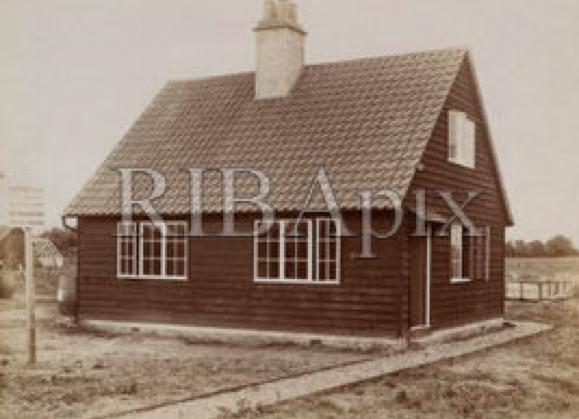
I was amazed to come across some more photographs of Francis Troup's cheap cottage in Letchworth Garden City.  This was the cottage for which he won first prize for the 'best wooden cottage costing under £150 to build' in 1905.  Troup won £50.  I posted some RIBA pictures of the cottage in a previous post.  This cottage, 124 Wilbury Road, looks similar in appearance to the Dye House on Kings Road.

Francis Troup's cheap cottage, 1905
from the Garden City Museum
The Garden City Museum website has a wealth of fascinating pictures of the building of Letchworth Garden City.  It's an interesting coincidence that the St Edmundsbury Weaving Works relocated to Letchworth Garden City in 1908.


The impetus behind the cheap cottage exhibition is explained by the Garden City Museum: "By the late 19th century the cost of building houses for farm workers was so high and wages so low, that it was not economical to build houses for agricultural labourers. Part of the problem was the restrictive bye-laws that allowed only expensive materials such as brick and stone to be used. This was one of the factors leading to a mass exodus of farm workers from country to town and a subsequent lack of labour.


To try to change this, Mr J St Loe Strachey, editor of The Specator and owner of the Country Gentleman Land & Water Magazine, wrote an article starting a campaign for the £150 Cottage which would use cheaper building materials and could be let to a rural labourers for an affordable £8 a year.
In an article in October 1904 he proposed a competition where entrants could display examples of cottages, free from byelaws, and thus able to utilise innovative new building methods and materials."
Postcard of the Cheap Cottages Exhibition  by Frank Dean, 1905
Garden City Museum
The Exhibition was opened in July 1905 by the Duke of Devonshire, the exhibition had a huge impact at the time "The exhibition acted as a publicity magnet.  In 1905, Letchworth was a household name with nationwide press coverage appearing in hundreds of national and local newspapers and the exhibition attracting between 60,000 to 80,000 visitors to the fledgling Garden City.  A new temporary stop was created on the Great Northern Railway to accommodate the throng – Letchworth was literally put on the map."
Cheap Cottage Exhibition, Letchworth, 1905
Garden City Museum
What is really fascinating about the Troup cheap cottage, is that I have come across a current photograph of the house online, so I feel able to share it here.  Below is one of the pictures I have posted previously of the cottage.
Cheap Cottage, designed by Francis Troup, Letchworth, 1905
RIBA
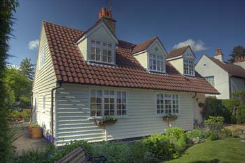
And here is the cottage today, there have obviously been a number of changes, but the cottage still remains recognisable from the 1905 pictures.  The changes made are fascinating, it looks almost like a new house, rather than one over 100 years old.  I wonder if they have any of Troup's trademarks still, like the very wide, robust front doors.  
Francis Troup's Letchworth cheap cottage, present day
Francis Troup's cheap cottage, 1905
from the Garden City Museum


Tuesday, 18 October 2011

A Peasant Break

After a busy few months completing my final project for my Finance MBA with Manchester Business School, I'm back and raring to go with some more Peasant Arts research!

My project was slightly thinner than Volume 1 of The Vineyard, edited by Maude Egerton King and Greville MacDonald.

The Vineyard, Fifield, edited by Maude Egerton King
& Greville MacDonald

Sunday, 28 August 2011

Francis Troup and the Art Workers' Guild

Before reading about the beginnings of the Arts and Crafts movement, I had not appreciated the significance of Francis Troup being a member of, and designing the Hall at the Art Workers' Guild.  This places Troup firmly in the midst of the Arts and Crafts movement.


Art Workers' Guild logo

As Walter Crane (who you may have noticed is my oracle on all arts and crafts events before 1900!) noted "The Art Workers' Guild...was able more effectively to raise the banner of Decorative Design and Handicraft and to gather under it a larger and wider representative group of artists" (Crane, Walter, An Artist’s Reminscences, The MacMillan Company, New York, 1907), than The Fifteen.  Crane explains the demise of The Fifteen in 1884 "we kept our meetings up for two or three years, and should, no doubt have existed for longer, but for the ultimate but natural absorption of our members into a larger Society, which was formed in 1884, with similar objects to ours, namely, "The Art Workers' Guild" (ibid).  The Art Workers Guild describe themselves as "founded in January 1884 at the Charing Cross Hotel. It was the coming-together of two existing informal discussion groups: The Fifteen, composed of designers like Walter Crane and Lewis F. Day; and the St George's Art Society, composed of six architects, all but one being pupils of Richard Norman Shaw".
No. 6, Queen Square,
address of the Art Workers' Guild


According to Crane, many members of The Art Workers' Guild had attended meetings of the Chelsea Conspirators.  He also observes that in 1888 as part of the Arts and Crafts Exhibition Society "many members of the Art Workers' Guild took a prominent part as presidents of various sections, as paper readers, or in the discussions"(ibid).
F.W. Troup in the 1920s


Stamp (Stamp, Gavin, A Hundred Years of the Art Workers Guild) describes of the Guild "Meetings are held fortnightly in the Hall built in the yard of No 6, Queen Square, and Bloomsbury. This hall is a convivial place it was designed by F.W. Troup and built in the 1913-14...(the Master) wears a chain of office made by Sir George Frampton, sits in a chair designed by W.R Lethaby for the short-lived firm Kenton & Co behind a table provided in 1888 as a temporary measure by W.A.S Benson. Members sit on (uncomfortable) ladder-backed, rush seated Clissett chairs, based on a design by Ernest Gimson. All very formal, very quaint, very traditional; yet within the Guild, as in civilization in a more general sense, a tradition may enshrine and pass on great truths about human nature and life. In the case of the Guild this truth is summed up in the motto on the Master’s chain and in the symbol above the Master’s chair, designed by Walter Crane: ‘Art is Unity’".


Troup Hall, drawn by Thomas Raffles Davison 1918


The hall Troup designed seems to also be called 'Troup's Hall' which is a lasting testament.  Stamp (ibid) remarks "A bust of Morris sits in pride of place in the niche above the Master’s chair in Troup’s Hall, yet when Morris’s name was first put up forward as a member in 1888 he was literally blackballed in the election.  Fortunately, owing to what Gordon Russell called ‘an entirely reprehensible and utterly justifiable bit of fiddling on the part of a scrutineer’, the black ball was deftly removed from the box."  When I included the drawing of Troup's Hall (above) in my earlier Troup post, I thought the ceiling was wooden beams, but looking at more recent photographs of the Hall I was surprised to see that it actually glass.


Troup Hall, Art Workers' Guild
In terms of Francis Troup's participation in the Art Workers' Guild, it would appear that he was a prominent member, although he seems to have not been an original member, joining in 1895.   I have just come across a very interesting directory that lists Troup's exhibitions, speeches and business interests ('Mr Francis William Troup', Mapping the Practice and Profession of Sculpture in Britain and Ireland 1851-1951, University of Glasgow History of Art and HATII, online database 2011).  An extract primarily listing the speeches he gave is below, from this his almost exclusive involvement in the Art Workers' Guild can be seen.


Extract of speeches and exhibitions of Francis Troup,
'Mr Francis William Troup', Mapping the Practice
and Profession of Sculpture in Britain and Ireland 1851-1951
,
University of Glasgow History of Art and HATII, 
online database 2011).
Parry refers to him as "architect of the Art Workers' Guild" (Parry, Linda, Textiles of the Arts & Crafts Movement, Thames & Hudson, 2005).  Troup became Master of the Art Workers' Guild in 1923 in recognition of "valuable and untiring services as Architect to the fabric of the Guild premises" he was made an ex-officio member of committee (The fifty-second annual report of the committee of the Art Workers' Guild, 1936).  
Gilbert Bayes (1872-1953),
dressed in the robe of Master of the Art Workers' Guild,
robe donated by F.W. Troup in 1924


Troup donated a number of items to the Art Workers' Guild:


  • Donated a red gown of office to be worn by the Master of the Guild and black gowns to be worn by the two honorary secretaries in 1924 [AWG annual report for 1924, p.10] - these robes are doubtless the ones referred to on the Art Workers Guild website, and were designed by Voysey: "The Master serves for a single calendar year, and is supported by two honorary secretaries. They conduct the formal business of meetings in robes designed by the architect C. F. A. Voysey."  This is complicated by a history of the Guild that says "The current Master wears a strange red
    robe, designed, some says, by Voysey (though Ashbee thought this, and other traditions, were created by Troup along with the Hall)."  (Stamp, ibid)
  • Troup was reported in the 1926 to have "not only safeguarded the interests of the Guild in connection with the new building next door [no further information given], but generously gave his 'party-wall' fee to pay for a new arrangement of the electric lighting of the Hall" [AWG annual report for 1926, p.9].
  • In Troup's will he left a bequest to the Guild of £250.  He also left "The Works of William Morris" (24 volumes), 'a collection of valuable books on Architecture and other crafts' (45 volumes), a collection of slides, a red painted table (designed and painted by Burne-Jones), two armchairs designed by W.R.Lethaby and E.Gimson [Fifty-eighth annual report of the Committee of the Art Workers' Guild, pp.5-6].
Troup Hall ceiling, Art Workers' Guild

Details are given on the same website of numerous talks that Troup gave at  the Art Workers' Guild, such as: 
  • the 1923 speech on 'Line': "Troup suggested a reconciliatory shaking of hands between Sullivan and Jackson at the end of the meeting"!
  • 'Scottish Art, 1500-1800' also in 1923: "Troup spoke with slides of Scottish buildings, gardens and illustrations of period domestic life, all lent by Sir R. Lorimer courtesy of J. Warrack." - this is interesting as Troup worked with Lorimer on Whinfold, the house at Hascombe in 1898
  • the 1925 talk on 'Substitutes in the Crafts': "Ladies' Night. Subject opened by H. Ricardo, followed by S. B. Caufield, A. Rackham, T. Wilson, F. W. Troup, C. R. Ashbee and N. Heaton"
  • the 1929 Inigo Jones speech: "J. A. Gotch read paper and showed slides, followed by (C.R.) Ashbee and Troup"
  • the 1938 speech 'Scotland's contribution to the Arts': "F. W. Troup spoke post-interval about Scottish architecture ancient and modern, showing many of his own drawings"
Past members of the Guild include the Dolmetsches, the famous Haslemere early music instrument makers.  Arnold Dolmestch was a member from 1899 and Carl Dolmetsch  in 1953.

Troup Hall detail, Art Workers' Guild

Sunday, 21 August 2011

Peasant Index - order to the chaos

When I started writing this blog, the thought of anyone other than myself or family under duress looking at it had not crossed my mind!  My posts probably appear chaotic to anyone except me, and therefore to give some order to everything I have just added a new page to the blog, an index.

I hope visitors find it helpful.

by Godfrey Blount,
from Arbor Vitae, Arthur Fifield, 1899

Saturday, 20 August 2011

Generational conflict?

Having read Walter Crane's memoirs, it has become apparent to me that Henry Hine and his daughters and sons-in-law may well have differed in their view of art.
Special edition of The Studio, 1906
from archive.org

Henry George Hine (Ethel Blount and Maude Egerton Hine's father) was a member of the Royal Institute of Painters in Water Colours ('the Institute') from 1864 onwards, becoming Vice President in 1887, a post he held until his death in 1895.  His son, Harry Hine became a member in 1879.

Wareham Bridge, Henry G. Hine,
from 
The Royal Institute of Painters in Water Colours,
The Studio, Special Number, Spring 1906

Walter Crane was a member of the Royal Institute of Watercolours from 1882.  Crane joined the Institute when it absorbed 'The Dudley', another watercolour group which organized an annual 'General Exhibition of Water-Colour Drawings' which was held in the Egyptian Gallery of the Dudley Gallery.  In 'The History of the Royal Institute of Painters in Water Colours' (The Royal Institute of Painters in Water Colours, The Studio, Special Number, Spring 1906) it is noted that the Institute gained from 'The Dudley' "some of the best men...amongst these men may be noted some like Richard Beavis, Walter Crane and Herbert von Herkomer...twenty-seven men all of repute and distinguished capacity".  There is another connection here as Godfrey Blount trained under Herbert von Herkomer at Bushey.

The admission of "The Dudley" members swelled the Institute to what seems today a modest number of eighty-nine.  Walter Crane exhibited a number of works including La Belle Dame Sans Merci in their new Piccadilly galleries in 1884.  

La Belle Dame Sans Merci, by Walter Crane
exhibited at the Royal Institute of Watercolours, 1884
The conflict in the art scene at the time however led Walter Crane to resign from the Institute in 1886, along with George Clausen, one of his fellow Chelsea Conspirators.  Professor von Herkomer also left the Institute in 1890.   They all joined the rival organization, the Old Watercolour Society; Crane joined in 1888, Clausen in 1889 and von Herkomer in 1893.  Referred to at the time as the 'Old Society', this  is now called the Royal Watercolour Society.  They describe themselves on their website as "second only to the Royal Academy of Art in importance as an art society".  Crane states that at the time of resignation, he had done so "with no thought of being a candidate for another body" (Crane, Walter, An Artist’s Reminscences, The MacMillan Company, New York, 1907), so it appears that the Old Society had not lured the members away.


The two main UK watercolour organizations c.1900,
both of which are still in existence today
Walter Crane refers to his resignation from the Institute in 1886 as a follow-on from the early history of the Arts and Crafts movement.  He reproduces a letter from Sir James Dromgole Linton, president of the Institute at the time, Crane comments that prior to the letter Linton had tried unsuccessfully to persuade him to withdraw his resignation, "my dear Crane, I am sorry there was no alternative but resignation" (Crane, ibid).  Interestingly Linton was residing at Haverstock Hill in 1886 as was Henry G. Hine and family.
Study of St Albans Abbey at Sunset,
Harry T. Hine, 1880

The discontent with the established art organizations at the time, is demonstrated by Walter Crane in his public request for sponsorship of the first exhibition of the Arts and Crafts Exhibition Society in 1888 "It has not been possible for a craftsman to test his work by the side of others, or, by a careful selection of examples, to prove that there are artists in other ways than oil or water colour, and other art than that enclosed in gilt frames or supported on pedestals." 
190-195 Piccadilly, London,
home of the Royal Institute of Painters in Watercolour 1883-1970
where Henry G. Hine was Vice President 1887-1895
Throughout the emergence of the Arts and Crafts movement, Henry G. Hine held the position of Vice President at one of the rigid arts establishments.  I wonder what debates may have been had between him, his son Harry and his daughters and sons-in-law?  Would Henry have embraced the diverse crafts that the Blounts and the Kings called art?  Ultimately it would appear that Henry G. Hine left many of his paintings to Maude Egerton King (his youngest daughter), so whatever differences they may have had about art were overcome.


Godfrey Blout, from Arbor Vitae, 1899

Thursday, 18 August 2011

Pre-Haslemere Peasant Houses

I do like snooping at other people's houses and I have been googling to look at the houses the key members of the Peasant Arts movement used to live in before they moved to Haslemere.  It is difficult to know whether road names or house numbers have changed since 1900, but hopefully I have been looking in the right places!

Joseph King
In 1881 King was living as the head of the household at Welford House, Hampstead.  There is a Welford House Residents Association registered at Arkwright Road, Hampstead NW3 6AA, so I was wondering if the house was on this road.  It no longer appears to be there, perhaps as a result of the heavy bombing of Hampstead during World War 2; there appears to be a number of high explosives and incendiary damage on Arkwright Road.  Welford House seems to now be a collection of new houses, however it presumably looked like one of the older houses on the road.

Typical Arkwright Road house, Hampstead, NW3 6AA

Welford House?  Hampstead

In 1891 Joseph King was living at 6 Wedderburn Road, married to Maude Egerton King.  The houses on both Arkwright and Wedderburn roads look quite substantial, and similar in design.
Typical Wedderburn Road house


Greville MacDonald
From 1867 the MacDonald's lived at The Retreat, now known as Kelmscott House, Hammersmith.  They sold the house to William Morris who renamed it and made it famous.  

The Retreat, childhood home of Greville MacDonald 1867- 1878


Drawing Room interior of Kelmscott House (formerly The Retreat) 1896,
when owned by William Morris,
Victoria and Albert Museum
Greville's father owned Casa Coraggio in Bordighera, Italy, and the family spent a lot of time there.  I understand that the house was a gift to George MacDonald from a fan. The Italian climate was thought to be beneficial for George's health and that of his children, tuberculosis killed four of Greville's siblings.


Interior of Casa Coraggio, by Irene MacDonald
from The George MacDonald Informational Web

Italian home of George MacDonald,
Casa Coraggio, Bordighera
Greville lived, and presumably operated his private practice also, at 85 Harley Street in the 1880s, and lived there until he moved to Haslemere in 1919.  In 1891 Greville's brother, Robert Falconer MacDonald, was also living with Greville and Phoebe.  He was the architect who designed the house St. George's Wood in Haslemere for his father, George MacDonald.  Greville had three servants, a cook, a housemaid and a professional nurse.  I do not understand the professional nurse being classed as a servant, was she a colleague of Greville's working for his practice?   Or maybe she was looking after Greville's wife Phoebe, who at around 1919 "lost her leg"(MacDonald, Greville, 1932, Reminiscences of a Specialist, London, George Allen and Unwin).

85 Harley Street,
home to Greville MacDonald until 1919
Maude Egerton King (nee Hine) & Ethel Blount (nee Hine)
The Hines were living at 26 Park Road, Hampstead in 1871.  I am not sure where this road is, perhaps it is the Park Road that runs alongside Regents Park from Baker Street.  This road continues as the A41 to St Johns Wood, Swiss Cottage and up to Finchley Road but it is renamed at several points.

In 1881 the family were living at 130 Haverstock Hill.  It looks like that house is no longer in existence, possibly bombed during World War 2 also.

Hine family residence 1881
Haverstock Hill, 130 on left?  Typical house on right
The Hine residence was close to nearby Arkwright Road and Wedderburn Road where Joseph King was living in 1881 and 1891 respectively, in 1891 with Maude Egerton King, his then wife.  As the Hine's had so many children, Maude as the youngest was in the unusual position of being just 2 years older than her niece Ellen Shenton (or Sheraton) who was also living at 6 Wedderburn Road with Maude and Joseph, and their two servants.

Nearby also in 1891 was Ethel.  Ethel Blount as she then was, was living with Godfrey Blount at 1 Church Row Mews, Hampstead.  I think this is now simply called Church Row, Hampstead Parish Church is on Church Row.  I wonder if the Blounts and the Kings visited the church?   In contrast to the others, Godfrey and Ethel had no servants living with them; they continued to be servantless in 1901 and 1911.

1 Church Row Mews?
Residence of Godfrey & Ethel Blount 1891

St-John-at-Hampstead, on Church Row, Hampstead

The proximity of the four different residences is highlighted in the map below.

Map of Hampstead highlighting the Kings, Blounts and Hines addresses
Godfrey Blount
Godfrey Blount's childhood house looks quite inferior in size and stature to those of the other Peasant Arts members.  He lived at 6 High Street, Bagshot.  According to the 1861 census there were 4 servants living here, including a governess, cook and a groom.  Including visitors, there were 13 people staying here in 1861, this makes me wonder how the photograph below can be the same address, as the house would have been overflowing.

6? High Street, Bagshot
home of Godfrey Blount 1861
High Street, Bagshot

I think these photographs show that the Kings, Greville MacDonald and the Blounts were all living in respectable houses prior to their move to Haslemere.  Joseph King, Greville MacDonald and the Hines houses were all quite substantial residences, and were members of a privileged class.  Godfrey Blount on the other hand appears to have been living in a much smaller residence but nonetheless a comfortable one.
Related Posts Plugin for WordPress, Blogger...