Friday, 6 January 2012

A Clearer Peasant Sleep!

Some of my Peasant Arts pictures on this blog are not of great quality, some of this I can blame on the age of the documents, but not all...!  The quality of the pictures is largely a result of using online copies of books and journals rather than the original paper versions.  So it is nice to come across some clearer copies of pictures that I've previously seen.
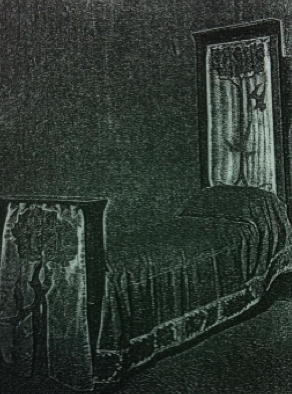
Oak bedstead designed by Ethel Blount, head, foot and quilt peasant tapestry
designed by Godfrey Blount from
The Artist, November 1897

This much clearer picture of the oak bedstead designed by Ethel Blount and head, foot and quilt of peasant tapestry designed by Godfrey Blount, quite literally sheds new light.  The detail of the tree and bird design on the head and footer tapestries and the edging of the quilt is drastically clearer, and looks a lot more attractive too.
Ethel Blount bedstead & Godfrey Blount peasant tapestries,
a worse picture, used in 18 June 2011 post
The Artist, November 1897
The Artist ('Two Surrey Village Industries', November 1897) stated "among the most beautiful of the Haslemere productions is a bedstead, with head and foot curtains of Peasant Tapestry and a quilt border with the same.  The body of the latter is of green linen, while the ground of all the applique-work is plain crash; the design is in delightfully harmonious greens and blues, with flowers of a soft but brilliant red.  The bed-stead, of green stained oak, is of Mrs. Blount's design, as is also the oaken wall-bracket, from which hangs a green linen curtain with a design in pale purple.  The colour is everywhere perfect except in one particular, and that is where purple and red are occasionally used in proximity".  Reading this description makes one further regret that the picture is only in black and white.

Thursday, 29 December 2011

St Christopher's Church and the unidentified Woven Hanging

St. Christopher's Church has a beautiful large piece of weaving for which they did not have specific details as to the origin.  The extremely helpful and friendly ladies of the church showed it to me.  They kindly laid a part of it out over the church chairs which are six chairs wide in each aisle.  This is a large and very heavy piece of weaving.  It was probably hung on one side of the altar, and so there may have been two of these hangings but now the church has only one.

Woven hanging, St Christopher's Church, Haslemere

All of the church's furnishing are handmade and numerous items were made locally; this suggests that this piece was made in Haslemere.  Whilst the hanging is not recognizably Peasant Arts, the grape and vine motif was popular with the movement and so therefore it seemed plausible that this was made by the Haslemere Weaving Industry on Kings Road.   The birds hiding in the corn seemed to be out -of-character however.
Detail of woven hanging, St Christopher's Church,
Haslemere
Having then found the publication Recent Eccelesiastical Architecture (Nicholson, C., and Spooner, C.,  Technical Journals Ltd., London, c.1910) where Charles Spooner (the architect of St Christopher's) states "Another interesting feature of the interior is the curtain dividing the choir stalls...It is a very fine piece of colour, and was woven at Haslemere", this would seem to support the view that the hanging above was made in Haslemere.  Therefore making it either a product of the St Edmundsubry weavers, whom did not appear to produce such primitive styles, or be produced by the Haslemere Weaving Industry, one of the Peasant Arts industries.  However this was before I had found the article quoted in my previous post (Art Journal, February 1911), whereby it can be identified that the curtain being referred to is Luther Hooper's wool curtain.
Detail of woven hanging, St Christopher's Church,
Haslemere


By chance my recent discovering of the Art Journal  online at British Periodicals conclusively solved the mystery.  This is not a Peasant Arts woven hanging.  Reading R.E.D. Sketchley's article 'Haslemere Arts and Crafts' (Art Journal, November 1906) I saw this hanging illustrated!  It is titled as "Vineyard Poplin, designed by Edmund Hunter, woven at the St Edmundsbury Weaving Works" (ibid).  
Vineyard Poplin, designed by Edmund Hunter
from Art Journal, November 1906
As Sketchley reports "The weaving works of Mr. Luther Hooper and M. Edmund Hunter are not peasant-industries.  They demand in the work a higher executive skill than is necessary for the (latter)...In place of the primitive treadle-looms a Jacquard hand-loom is used...The St. Edmundsbury works had their beginning in Mr Hunter's experience as a designer for manufacture, a pattern-maker for materials and processes whose possibility is only theoretically apprehended...It had final issue in the starting of weaving works at Haslemere, with skilled weavers from Spitalfields to carry out their traditional craft, under the direct supervision of the designer....In the church textiles which are an important part of his industry, as in the more ornate designs for brocade, Mr Hunter's use of animal forms among the emblematic flowers points to inspiration from the great textiles of mediaeval Sicily, the wonderful webs whose romantic fantasy captures the sense of all those who respond to imagination in art.  But when he uses traditional forms, conventional or symbolic, the designer regards them for the purpose of the present, and in that spirit has produced in twentieth-century Haslemere some works of rare and quick beauty."

To have re-discovered the designer of this hanging, and that it was not the designer whom was expected feels quite remarkable.

Tuesday, 27 December 2011

St Christopher's Church and Luther Hooper Part 2

Having done some more searching, I have found some more details about Luther Hooper's work at St Christopher's.  Unfortunately I have not physically located the actual works!
St. Christopher's Church, Haslemere c.1911
from Art Journal, February 1911

In the Art Journal (February 1911) Luther Hooper wrote the first of two articles under the heading 'Art of To-day.  Fine and Otherwise: Art in the Church'.  Hooper uses St Christopher's Church, Haslemere to illustrate his message "In the church, if anywhere, everything should be made or carefully selected for its special place and use; all should be of the best of its kind and in harmony with all the rest.  In fact art, in the church particularly, should be alive.  This can never be if things are used which have been made at the lowest rate simply for money, and safely stocked by the tradesman and sold merely for profit...About St Christopher's, Haslemere there is nothing commonplace or ordinary, and at the same time nothing is bizarre or out of harmony.  The church was built a few years ago, Mr. Charles Spooner being the architect , and from the first the committee wisely resolved not only to entrust the design of the fabric to him, but to take his advice on all matters of detail and furnishing.  At the beginning only the absolutely necessary items were provided, and the congregation has been adding to them from time to time as circumstances allowed."
Portion of Silk Damask, Side Curtain to Altar,
St. Christopher's, Haslemere
designed by Luther Hooper
from Art Journal, February 1911

The damask above is described as "red-gold silk damask altar curtains", from the photograph of the altar taken around the time, and also illustrated in the Art Journal.  Spooner describes that the "altar curtains are of red silk damask with copper coloured silk lining, designed by Luther Hooper" (Nicholson, C., and Spooner, C., Recent Eccelesiastical Architecture, Technical Journals Ltd., London, c.1910).  I cannot identify the silk damask hung in the photograph below to be the same as that shown in detail above.  Hooper describes that "their copper-coloured silk lining was woven by Messrs. Warner and Sons of London to the design of the writer" (Art Journal, ibid).
Holy table by Arthur Romney Green,(Nicholson, C., and Spooner, C., Recent Eccelesiastical Architecture, Technical Journals Ltd., London, c.1910)
The damask identified in the previous post is reproduced in the Art Journal and is shown in situ.  "Behind the choir stalls, opposite to the organ, is the choir vestry.  It is only divided from the chancel by a heavy curtain.  This curtain, of rich, bright colour, is not one of the least features of the decoration of the church.  It is very heavy and wide.  It measurer nine feet in height by twenty-two feet in width when extended.  As it occupies only a space of eleven feet it naturally gathers up into beautiful and ample folds.  It will be seen by the photograph that the curtain is not gathered formally into the usual band, but is allowed to hang in free folds from a lacing of leather thongs which suspend it more than a foot below a strong iron rod.
Luther Hooper wool hanging fromHand-loom weaving, plain & ornamental,
Pitman & Sons, London, 1920

"The material of which the curtain is woven is fine wool and the colours are scarlet, cream, green and dark blue.  The dark blue is the background.  The vase and conventional plant is green, as is also the acanthus leaf which forms the structure of the design the latter being outlined with cream colour.  The cream colour also outlines the brilliant scarlet lily which gives point and character to the whole.
Curtain of Woollen Tissue, St Christopher's Church,
designed by Luther Hooper, woven by Percy C. Hooper,
from Art Journal, February 1911

"...On the reverse side, facing the choir vestry, the curtain is lined with a soft, strong material made of pure mercerised cotton.  This is shown below the design "shows the somple design design of vine leaves and grapes and boundaries.  The colours in the ornament are the same as those the wool surface of the curtain - blue, green and red - but these are much modified in strength by being interwoven with the cream colour of the ground." (ibid).  Unfortunately the British Periodicals copy of the Art Journal online (I have access through my University) is not a good photocopy, and hence the pictures are very dark.

Reverse Side of Curtain (from above), Woven in pure cream mercerised cotton,
ornamented with green, blue and scarlet wool
Art Journal, February 1911
Spooner states that "another interesting feature of the interior is the curtain dividing the choir stalls from the vestry...It is a very fine piece of colour and was woven at Haslemere" (Nicholson, C., and Spooner, C., Recent Eccelesiastical Architecture, Technical Journals Ltd., London, c.1910).  Hooper states that the wool damask was woven in the weaving house which was at the time of his writing the location of the Country Church (on Kings Road).

Monday, 26 December 2011

A Peasant Xmas!

Having a last minute gift tag disaster, I quickly knocked up some tags using a few Christmas-like images from Godfrey Blount's Arbor Vitae and Ethel Blount's Gifts of St Nicholas.  Combined with our printer having a fondness for green, we quickly had some reasonably passable festive gift tags.

I am not sure the Blounts would have approved, but they looked quite nice.

Merry Christmas!

Images from Blount, Godfrey, Arbor Vitae, 1899 and Blount, Ethel, Gifts of St Nicholas

Friday, 23 December 2011

Arthur Romney Green & the Peasant Arts people

Arthur Romney Green (A.R.G.) had holidayed in Haslemere during his childhood, his parents being friends with Sir Robert and Lady Hunter.  When A.R.G. and his wife Florence moved to Haslemere in 1902 from Bosham at the age of 30, they first lived in a rented house called 'Down End' in Hindhead.  Elkin reports that the Hunters "introduced Green and Florence to the local circle of cultured, and often wealthy, people...Green took a little workshop in Foundry Road, near Haslemere railway station.  There he often met, and made friends with, the sort of company which Florence disliked - social reformers, social philosophers, pamphleteers and champions of 'bottom dogs'." (Elkin, Susan, Life to the Lees, Cromwell Press, 1998).
Arthur Romney Green at his Christchurch workshop in the 1920s
(in the doorway wearing a black jacket).  Note the chair back glimpsed in the window
and his name above the door

Doubtless Elkin is referring to the Blounts and the Kings when she writes this, who ticked all those boxes: Joseph King MP being the most prominent social reformer, Godfrey Blount being the social philosopher and, them both, including their wives Maude Egerton King and Ethel Blount producing pamphlets and championing the peasant life.  The Weaving House and Tapestry Studio which they operated would have been well-known in 1902, and A.R.G.'s workshop would have been located within  a 100 metres of them.  Behind the workshop, Godfrey and Ethel Blount may still have been living in Foundry Cottage on Foundry Lane (where they were in the 1901 census), or they may have moved into St. Cross on Weydown Road.  I wonder how the Christchurch workshop pictured above, compared to the Foundry Road workshop?  As noted in a previous post, the workshop must have been a reasonable size because A.R.G. and Harold Murray "started an Independent Labour Party (ILP) group which met in the showroom...Sometimes as many as 40 or 50 people attended the meetings: a mixture of small tradesmen, artisans, the men who worked for Green, and sometimes, a sprinkling of local bigwigs".  For A.R.G. to be holding such meetings on Foundry Lane sounds very similar in pretext to the Blounts and Kings political and religious meetings also held locally.

Arthur Romney Green from
Green, A. Romney, A Craftsman's Anthology, 
University Press, Aberdeen, 1948 (edited and abridged by Joan Yeo)
Elkin only refers specifically to one of the Peasant Arts people, Godfrey Blount.  A.R.G. left Haslemere in disgrace when he left his wife and child for Bertha Murray; Bertha left her husband and two children to be with A.R.G.  Elkin describes how the Murrays had moved from Hampstead where they had lived in the late 1880s and early 1890s.

Harold Murray had an established dental practice and it is probably through living in Hampstead that he knew Ethel and Godfrey Blount and perhaps also Maude and Joseph King.  The Murrays moved to California to pursue a new career in fruit farming but after a while ill health and financial difficulties caused Harold to give this up and take on the managership of a small gold mine.  "Then the proprietor of the mine defrauded Murray out of a year's salary.  This completed their ruin.  The couple - with a son in his early teens and a new baby daughter - returned to England, probably in 1902, with the help of their old friend Godfrey Blount.  They had to leave behind the piano, their library of books and almost everything they had of value.  It was at Blount's house in Haslemere that Green first met them." (ibid).  A.R.G. went on to organize political meetings with Harold Murray that he held in his workshop.  I wonder how Godfrey Blount felt a few years later, when A.R.G. and Bertha Murray left Haslemere to be together, about having first introduced the Murrays to A.R.G.

I had hoped that A.R.G.'s A Craftsman's Anthology (University Press, Aberdeen, 1948) would include some writings by the Blounts, Kings or Greville MacDonald.  Sadly they do not feature.  Amidst the extracts of Walt Whitman, Emerson, Carlyle, Shakespeare and Homer, the nearest links to the Peasant Arts movement are Tennyson (Haslemere resident), G.K.Chesterton who was patron of the Peasant Arts Guild in 1925 and the writings of John Ruskin which also inspired the Peasant Arts movement.

Wednesday, 21 December 2011

St Christopher's Church & Arthur Romney Green's chair

As well as designing the altar table for St Christopher's Church, Arthur Romney Green (A.R.G.) also designed the altar chair.  The chair displays Green's distinguishable design traits, through the geometric seat back to the carved back uprights and arm supports.  The shaping on the legs is reminiscent of the shaping of the altar table legs, however it is closer in design to the Gimson 1906 chair legs of my previous post, although ARG's chair dates I believe from 1903, the same year as the altar table.


Altar chair, by Arthur Romney Green c.1903  

Altar chair, by Arthur Romney Green c.1903

Altar chair detail, by Arthur Romney Green c.1903
The 'dash' design that borders the chair arms, seat, rail and base is repeated on the front oak choir stalls, suggesting therefore that these are also from A.R.G.'s Foundry Meadow workshop.

Choir stall, St Christopher's Church
possibly designed by Arthur Romney Green
A.R.G. has chairs in other churches, most notably at Christchurch Priory where this ceremonial chair (c.1926) is in the Lady Chapel.
Ceremonial chair by Arthur Romney Green,
Christchurch Priory from 
Elkin, Susan, Life to the Lees:
A Biography of Arthur Romney Green
, The Cromwell Press Limited, 1998

Friday, 9 December 2011

St Christopher's Church & Arthur Romney Green's table

The work of Arthur Romney Green is prominent in St Christopher's Church.  In the words of St Christopher's architect, Charles Spooner, "the oak, "Holy Table" was made in the local workshop of Mr. Romney Green and is set against a reredos of oak with carved enrichments gilded and a number of panels which are to be decorated with tempera paintings by Mrs. Spooner" (Nicholson, C., and Spooner, C., Recent Eccelesiastical Architecture, Technical Journals Ltd., London, c.1910).   


Holy table by Arthur Romney Green,(Nicholson, C., and Spooner, C., Recent Eccelesiastical Architecture, Technical Journals Ltd., London, c.1910)
A current woodworker called Bert Wynn is quoted as stating that Arthur Romney Green's "best work (is) outstanding for 'the sheer quality and artistry of the design.'  Having himself tried to make tables and chairs to Green's designs, he finds that 'the reason modern furniture makers cannot produce those things is that they can be executed only with hand tools.  I think Green was easily the most gifted designer working in the period 1900-1940, although he goes largely unrecognised' (Elkin, Susan, Life to the Lees: A Biography of Arthur Romney Green, The Cromwell Press Limited, 1998).


Arthur Romney Green was based in Foundry Meadow from 1902 to 1908 or 1909.  He had a workshop with a showroom above it.  I wonder whereabouts on the current Kings Road he would have been based.  I presume his workshop and showroom would have stood either between the Dye House and Greenbushes, or on the other side of the road, backing onto the railway line somewhere past the Tapestry Studio, up to anywhere opposite the Dye House.  
Handicrafts of Haslemere leaflet, 1902
reproduced courtesy of Haslemere Educational Museum,
Arthur Romney Green's Woodworking Industry features
at the bottom of the listing shown


The building must have been reasonably large given that himself and Harold Murray "started an Independent Labour Party (ILP) group which met in the showroom...Sometimes as many as 40 or 50 people attended the meetings: a mixture of small tradesmen, artisans, the men who worked for Green, and sometimes, a sprinkling of local bigwigs" (Elkin, ibid).  It was with Harold's wife, Bertha, that Green would leave Haslemere "in disgrace" some years later, but more on that in another post!  It does however make you wonder what the parishioners must have thought in 1909 about having a Holy Table made by a local married man who had "ran off" with another local man's wife.


Sadly the beautifully decorated table legs of the Holy Table are now hidden by the altar cloths.  Clearly the legs were intended to be seen, as shown in the photograph above.  The hexagonal shaping of the legs, decorated with interspersed diagonal stripes and leaves is clearly recognizable as a Arthur Romney Green (A.R.G.) design.  Much of A.R.G's work reflected his mathematical training through strong geometrical patterning.  


Peeping under the altar cloth,
detail of Arthur Romney Green 'Holy Table'
at St Christopher's Church, Haslemere
The detail can be better seen in the photograph below, which is taken from the Record recently made by the Haslemere Decorative and Fine Art Society (DFAS) which painstakingly recorded every item within St Christopher's Church according to a standard format designated by the National Association of Decorative and Fine Arts Societies (NADFAS).  I had thought the leaves depicted were oak leaves, but looking at the detail on the photograph below, perhaps they are vine leaves which the Peasant Arts movement frequently used to decorate craft pieces.


Arthur Romney Green 'Holy Table' leg detail,
St Christopher's Church, Haslemere
from St Christopher's Church DFAS Record
A present day picture without the altar cloth, contained in the DFAS Record provides a contrast to the c.1910 photograph of the same subject.  Mrs Spooner's tempera panels are now in place.


Holy Table by Arthur Romney Green,
St Christopher's Church, Haslemere
from St Christopher's Church DFAS Record
'Holy Table' by Arthur Romney Green at
St Christopher's Church, Haslemere
from Nicholson, C., and Spooner, C.,
Recent Eccelesiastical Architecture,
 Technical Journals Ltd., London, c.1910
The Holy Table as it is seen in St Christopher's Church today, with no clue of what lies beneath the altar cloth.


St Christopher's Church Holy Table, Haslemere


There are a number of examples of tables designed by A.R.G. on the internet, although none look similar to the Holy Table.


Arthur Romney Green table
at Hill House Antiques
The legs on the table designed by Ernest Gimson, another and more famous woodworker of A.R.G.'s time, below have been attributed to H. Pugsley, and appear to be similar to the Holy Table legs.  Hill House Antiques note the similarity of what they describe as "heavily chamfered/ typically fawcetted legs" to A.R.G.'s work, and suggest that he was influenced by Gimson's work.  No doubt he was, but this piece appears to have been made after A.R.G.'s Holy Table: the Gimson table was made in 1906, whereas the Holy Table is attributed to A.R.G. in the October 1903 Parish Magazine (St Christopher's Church DFAS Record).


Gimson table c.1906
from Hill House Antiques
Chamfered table leg detail, Ernest Gimson
from Hill House Antiques

Related Posts Plugin for WordPress, Blogger...