Haslemere Peasant Tapestry on the cover of the newly published 2017 Annual Report of the Haslemere Educational Museum.
A blog recording the Peasant Arts movement in Haslemere, Surrey, UK around the early 1900s, and it's founders Joseph King, Maude Egerton King, Godfrey Blount, Ethel Blount and Greville MacDonald. Arts and crafts, religion, literature, architecture, suffragettes, family trees, local locations and strong beliefs, this story has it all. Over a century later, their promotion of the pleasures of homemade craft is still relevant today.
Friday, 31 August 2018
Monday, 2 April 2018
Godfrey Blount & the Peasants in New Zealand
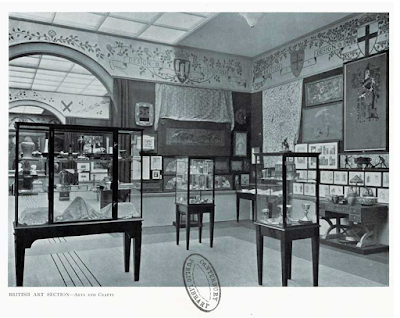
The work of the Haslemere Peasants was exhibited in New Zealand as part of a British Government exhibition. The Arts and Crafts works were curated by Walter Crane.
In 5 December 1906 there is an article in Evening Post describing "the room at the Exhibition Art Gallery devoted to craft works. These were sent out by the British Government as examples of the ideals to follow in our struggle for the beautiful...A visit to the wall in the Craft room specially devoted to the craftwork of William Morris, shows his marvellous power over tone applied to textile manufactures, in all its force.
"One of his energies was the starting of cottage weaving, now carried on by Godfrey Blount, an architect, of Hazlemere (sic), a village in Surrey, Mr Edmund Hunter, of the Edmunds Association of Weavers, and others. They have on view a large and varied collection of hand-woven articles, beautiful in design, in colour and in texture. No. 234 is a hand-spun silk, founded on the thistledown, and has all the lightsome beauty of the down in colouring, and a lightly suggested head of thistledown all over the fabric makes a very fine piece of design. A great deal of the work of the cottage weavers is on view in glass cases about the British sector. Some of these are exceptionally beautiful in texture, and certainly fulfil the adage “that strength and honour are in her clothing.” One especially lifts itself out as more than usually lovely. It is a combination, woven of silk and linen, in flashing grass green colouring, and for perfection has hardly ever been surpassed. These handwoven linens and silks are woven in the cottages of the English villagers by the women themselves. These are for a lifetime. Any housewife who has been lucky enough to own a pair of Irish linen sheets, made by the Irish weavers in their homes, will appreciate what it would mean to have their tablecloths, linen sofa covers, and cream canvas curtains hand-woven.
"All of these articles are shown here, the produce of spare time in quiet English villages. The men are away working all day, and the Peasants’ Arts Society have endeavoured, with what seems astounding success, to put artistic craft into the hands of the cottagers, and at the same time to put money into their pockets. ..There is another, door-hanging, hand woven, No. 347, with a design of a vine intertwined with the grapes, and a flying bird. This shows how it is possible to harmonise contrasting colour. The colour scheme is a deep olive-green, deep scarlet, deep blue, and deep organe, and in the hands of any one but an artist, such a combination would have made the hanging a thing of horror, a nightmare, where this is quiet and harmonious. This was designed by Edmund Hunter and woven by the St Edmund’s Weavers Society.”
Christchurch City Libraries (here) describes the 1906 Exhibition thus "The art exhibition proved hugely popular, attracting one and a half million visitors. "To a great many New Zealanders the British Art display… was the most attractive section of the Exhibition". It was gratifying, the Press enthused, that New Zealanders should have the opportunity to see the largest art exhibit ever shown by the Mother Country at an international exhibition...The exhibition of British art at the International Exhibition was the first major collection of non-colonial art seen in New Zealand. The collection "was one of the most perfect … ever sent from Great Britain, and by far the finest ever shown in a British colony"...
In 5 December 1906 there is an article in Evening Post describing "the room at the Exhibition Art Gallery devoted to craft works. These were sent out by the British Government as examples of the ideals to follow in our struggle for the beautiful...A visit to the wall in the Craft room specially devoted to the craftwork of William Morris, shows his marvellous power over tone applied to textile manufactures, in all its force.
![]() |
| The British Government Arts and Crafts Exhibit at the New Zealand International Exhibition, 1906 |
"One of his energies was the starting of cottage weaving, now carried on by Godfrey Blount, an architect, of Hazlemere (sic), a village in Surrey, Mr Edmund Hunter, of the Edmunds Association of Weavers, and others. They have on view a large and varied collection of hand-woven articles, beautiful in design, in colour and in texture. No. 234 is a hand-spun silk, founded on the thistledown, and has all the lightsome beauty of the down in colouring, and a lightly suggested head of thistledown all over the fabric makes a very fine piece of design. A great deal of the work of the cottage weavers is on view in glass cases about the British sector. Some of these are exceptionally beautiful in texture, and certainly fulfil the adage “that strength and honour are in her clothing.” One especially lifts itself out as more than usually lovely. It is a combination, woven of silk and linen, in flashing grass green colouring, and for perfection has hardly ever been surpassed. These handwoven linens and silks are woven in the cottages of the English villagers by the women themselves. These are for a lifetime. Any housewife who has been lucky enough to own a pair of Irish linen sheets, made by the Irish weavers in their homes, will appreciate what it would mean to have their tablecloths, linen sofa covers, and cream canvas curtains hand-woven.
"All of these articles are shown here, the produce of spare time in quiet English villages. The men are away working all day, and the Peasants’ Arts Society have endeavoured, with what seems astounding success, to put artistic craft into the hands of the cottagers, and at the same time to put money into their pockets. ..There is another, door-hanging, hand woven, No. 347, with a design of a vine intertwined with the grapes, and a flying bird. This shows how it is possible to harmonise contrasting colour. The colour scheme is a deep olive-green, deep scarlet, deep blue, and deep organe, and in the hands of any one but an artist, such a combination would have made the hanging a thing of horror, a nightmare, where this is quiet and harmonious. This was designed by Edmund Hunter and woven by the St Edmund’s Weavers Society.”
Christchurch City Libraries (here) describes the 1906 Exhibition thus "The art exhibition proved hugely popular, attracting one and a half million visitors. "To a great many New Zealanders the British Art display… was the most attractive section of the Exhibition". It was gratifying, the Press enthused, that New Zealanders should have the opportunity to see the largest art exhibit ever shown by the Mother Country at an international exhibition...The exhibition of British art at the International Exhibition was the first major collection of non-colonial art seen in New Zealand. The collection "was one of the most perfect … ever sent from Great Britain, and by far the finest ever shown in a British colony"...
"An important Arts and Crafts section, with 690 works by 171 artists, was put together by Walter Crane and Alfred Longden. This section included furniture and furnishings, textiles, jewellery, metalwork, book bindings, glass, ceramics, mosaics, wood carvings, silver and illuminations. Nearly half the exhibitors were women, including the only New Zealander, Alice Beatrice Waymouth of Christchurch who exhibited art jewellery work and sold 8 pieces.
The New Zealand Government paid for the collection of the works, packing, insurance, transportation and the cost of installation, a total of £7126."
Saturday, 31 March 2018
Friday, 30 March 2018
The Utter Gladness of the Spring by Godfrey Blount
Thursday, 29 March 2018
Godfrey Blount, the Peasants & the Clarion Guild of Handicraft
In 1901 Blount is described as “urging
the readers of the Clarion to pay
more attention to Morris’s aesthethic theories.
In response, Julia Dawson helped to launch the Clarion Handicraft Guild ‘Joy
in work, and hope in leisure’ became their motto” (Waters, Chris, British Socialists and the Politics of Popular Culture, 1884-1914, Manchester University Press, 1990, p173).
![]() |
| The Comrade, Volume 3, Number 3, p.57 |
Godfrey Blount’s applique panel ‘The Spies’ which
is held by the Victoria & Albert Museum, is recorded as being exhibited in 1903
at the second annual exhibition of the
Clarion Guild. The Peasant Arts Society is
listed as lending it's sympathetic support to the exhibition as one of the “best-known
and most successful craftsmen and craftswomen in the country” (Spargo, John, ‘Socialism and the Arts and Crafts
Movement’, The Comrade, Volume 3, Number 3, p.57 ) Edmund Hunter also exhibited a woven strip.
![]() |
| from The Comrade, Volume 3, Number 3 |
The Clarion Guild of Handicraft encouraged ordinary people to undertake handicrafts "As most of the members are workingmen and women who have to
earn their living during the day, they are only able to devote their scanty
leisure to the pursuit of the their ideals in this direction. They rent a room for guild purposes, holding
meetings for discussion, classes, and the like, and doing their work there. Thus they overcome a very serious obstacle
which the lack of room in their homes presents.
They avoid making workshops of their already too cramped and overcrowded
homes. …Annual exhibitions are a feature
of the new movement and a beautiful challenge shield of embossed colored
leather, the work of a member of one of the Guilds, is awarded to the local
Guild which makes the best exhibit. At
the second annual exhibition, held in the quaintly beautiful city of Chester,
last Easter, Walter Crane, in a felicitous speech awarded it to the Liverpool
Guild." (ibid.)
![]() |
| The Comrade, Volume 3, Number 3, p.57 |
As Spargo concluded "Why should we not have Socialist Handicraft Guilds in this country? I see no reason why we should not have "Comrade Guilds" patterned after the "Clarion Guilds". For we, too, are of the faith." (ibid.)
Edmund Hunter's Stag & Deer Silk Panel
This silk panel that was auctioned in 2017 shows in my mind an influence from the Haslemere Peasants. Vine leaves, grapes and deer, it has all the ingredients of Godfrey Blount's designs. Made by Edmund Hunter's St Edmundsbury Weavers, suggested to be made around 1900, when the St Edmundsbury Weavers were based at College Hill, Haslemere.
The piece is described as:
"ATTRIBUTED TO EDMUND HUNTER FOR ST EDMUNDSBURY WEAVERS
STAG AND DEER SILK FABRIC HANGING PANEL, CIRCA 1900
depicting opposed stags on a vine ground, within grey silk border
42 x 49.5cm, including border 70 x 76.5cm
Estimate £ 200-300 "
![]() |
| St Edmundsbury Weavers Stag and Deer Silk Fabric Hanging from Lyon&Turnbull |
"ATTRIBUTED TO EDMUND HUNTER FOR ST EDMUNDSBURY WEAVERS
STAG AND DEER SILK FABRIC HANGING PANEL, CIRCA 1900
depicting opposed stags on a vine ground, within grey silk border
42 x 49.5cm, including border 70 x 76.5cm
Estimate £ 200-300 "
![]() |
| St Edmundsbury Weavers detail from Lyon&Turnbull |
The piece sold for £1,000.
Saturday, 17 March 2018
Royal Academy artists petition for H.G. Hine’s family
There is a letter on eBay that is currently for
sale $500, you can purchase it here.
Dated June 1913, on headed paper from the private members
club, The Athenaeum, Pall Mall, the letter is addressed to the Prime Minister.,
Herbert Henry Asquith.
“We desire to bring to your notice the claims for a Civil
List Pension of the three unmarried daughters of the late Henry George Hine –
Vice President of the Royal Institute of Painters in Water Colour.
Mr H. G. Hine was held in very high esteem both as an artist
and a man by the leading members of his profession. He was one of the first contributors to
“Punch” and drew for other publications.
Later in his life he took on any?? High position as an exponent of the
essentially British Art of Water-Colour painting. His refined and thorough work – reflecting
his loveable & gentle character-revealed to his fellow countryman the
beauties of the South Downs, the charms of his native County of Sussex. His pictures are always sought after for International
Exhibitions. Where they are certainly
valuable additions to the British Section.
He died at an advanced age, working till within a few days of his death. He had a large family & died poor.
This appeal to aid his three unmarried daughters is to
enable them to rest from the work which up to the present they have bravely
continued
The ages of these ladies are seventy, sixty-six and
sixty-four."
A number of signatures, of which the following names can be
deciphered (or copied from the write-up on the sale):
"Edward J. Poynter
Ernest Waterlow
Walter William Ouless
Frank Dicksee
Hubert von Herkomer
William Blake Richmond KCB RA
Briton Riviere
George Clausen
John Seymour Lucas"
Looking at the Hine family tree, I think the 3 sisters that the petition is requesting a Civil List pension for are:
Alice Hine (1843-?)
Elizabeth M Hine (1846-1922)
Subscribe to:
Posts (Atom)


