Sunday, 24 July 2011

Walter Crane & the Chelsea Conspirators - Arts and Crafts movement

I am exploring the emergence of the Arts and Crafts movement here to better understand it, and also as I have found that whilst the works of the Arts and Crafts movement is well-known, what sparked the movement itself off is not very well known at all.  Having read further into Walter Crane’s An Artist’s Reminscences (The MacMillan Company, New York, 1907) I am less convinced of the significance of the Fifteen as a precursor to the Arts and Crafts Movement as a whole.  I believe that is an over-simplistic interpretation of events at the time.  There were numerous groups from 1881 onwards, of artists, in the wider sense of the word, joining together to discuss a more comprehensive view of art and design.  
Burlington House, Piccadilly, London
home of the Royal Academy since 1867 & catalyst for the
Arts and Crafts Movement
Crane writes that “In the summer and autumn of 1886 I was considerably engaged in agitation for a really representative National Exhibition of Art as distinct from the Royal Academy and its methods, and on much broader and more comprehensive lines, including a better representation of architecture and sculpture, as well as decorative design and handicraft.
The New English Art Club, established in 1885

"There had been rather more than the usual crop of surprising rejections at the Royal Academy that year, and the group of artists who then formed the leading spirits of the New English Art Club felt that something ought to be done – if only to bring their own forms of art more prominently before the public.

"There was a lively correspondence in the newspapers; the subject became a quite exciting topic – in fact, a burning question, as indeed it is apt to do when it happens to suit the convenience of editors as copy to fill their sheets with when the silly season comes on.

"In 1886, however, things looked really more serious.  Complaints were loud and deep from disappointed artists and their friends, and grew into something like a clamour.” (ibid).
Sir George Clausen, Study for a self-portrait,
probably early-mid 1880s, Royal Academy

It is here that George Clausen, then a prominent member of the New English Art Club played a important part.  He contacted Walter Crane to try and convince him to influence the creation of a new movement “which will help to place art matters – or rather the exhibition of pictures and sculpture on a better footing than they now have here…instead of making another little society, to start if possible a national movement on a broad and fair basis…an exhibition open to all artists…every artist who has exhibited in the United Kingdom in the last three years (to be) invited to send…Every artist will be eligible to serve on the hanging and selecting committees, and will have a vote for these committees, that is the principle – that artists have the right to elect their own committees (i.e. juries) – what could be more simple or more just?” (ibid).

These principles encapsulate those that were then adopted by the Arts and Crafts Exhibition Society.  It is interesting to read them asserted by an artist not primarily linked to the Arts and Crafts movement now, as clearly his contact with Walter Crane was a significant contribution.
William Holman Hunt, Self portrait, 1867,
Galleria degli Uffizi
Crane recalls that “these principles at once claimed my sympathy, and after a lengthy correspondence, Clausen drafted a letter for publication, embodying these principles…asking me, if it had my approval, to sign it…we then asked Mr. Holman Hunt (who was engaged in the newspaper warfare on the question at the time) to sign it also, which he agreed to do, and in the letter I received from him a the time he says: - “I gladly sign, finding it to express in a manly and distinct manner the absurdity of the position of English artists in the present day, and to appeal not less distinctly for a redress of injustice which the Royal Academy does to the whole profession by its opportunity to assume authority over without acknowledging responsibility towards outsiders.

"The letter with our joint signatures duly appeared in all the principal papers and attracted a considerable amount of attention and discussion." (ibid)

Clausen, Crane and Hunt then followed up the letter with an appeal to artists to support this proposal.  Their letter read:
Exterior of Wentworth Studios, Manresa Road, Chelsea
Meeting place of the Chelsea Conspirators,
from the London Metropolitan Archives, City of London

“Dear Sir, - The proposals for a National Exhibition of Art lately put forth in the public press have raised the whole question of the adequacy of the present representation of the Arts in Exhibition.

The principle put forth in these proposals, namely, that artists should have the right to choose the committees entrusts with the selection and placing of their works, the undersigned hold to be sound and just, and that it is the basis on which a representative Exhibition of the Arts should be conducted.  Believing that it will, on fair consideration, meet with the agreement and cordial support of artists generally, they beg to ask you if you will consent to join with them in forming a Provisional Committee to consider the best means of carrying out this principle?......

(Signed) George Clausen, Walter Crane, W. Holman Hunt
N.B. – Informal meetings are held each Saturday evening at he studio of J.H. Thomas (1 Wentworth Studios, Manresa Road, Chelsea) of the friends and supporters of the movement, and all artists interested are invited to attend and state their views freely.” (ibid)
Frederick Brown by Philip Wilson Steer, 1894
National Portrait Gallery

Crane goes on to describe that “We had a large number of adherents among the artists, and the meetings at Chelsea were very numerously attended, and there being so many of the Chelsea colony in the movement and the meetings being held there, we were eventually nicknamed “The Chelsea Conspirators”.

Crane lists some of these “conspirators”:
  • "Mr. Frederick Brown, now Slade professor at University College, was elected Chairman of these meetings
  • Mr. Whistler gave us his benison, but did not attend
  • Mr. Oscar Wilde was present on one occasion and spoke, I think
  • Mr. H. H. La Thangue (who acted as Hon. Secretary pro tem.) was keenly interested in the movement
  • Mr James Stanley Little (at one time the active Secretary to the Shelley Society) also worked hard in the movement, using his pen vigorously, and really he remains one of the few men in it who have stuck to their guns.
  • Mr. S. J. Solomon
  • Mr. T. B. Kennington
  • Mr. M. H. Spielmann" (ibid)
Henry La Thangue, self portrait, 1890
Dunedin Public Art Gallery, New Zealand

Crane notes that George Clausen, Mr. H. H. La Thangue and Mr. S. J. Solomon “have all since those days been admitted into the Academic citadel.  The walls of Jericho refused to fall at the sound of the Chelsea trumpets, so in the end certain of the trumpeters went in to reinforce (not reform) the garrison!

"Much steam was let off, and I think much time and energy wasted, and although, ostensibly, the object was to further the original scheme of a National Exhibition of Art, with a jury annually elected by the artists of the country, and make a wider appeal, so as to enrol a very large body of supporters, one became aware that behind a few earnest men there were others who were by no means anxious to see the scheme realised, and the result was the when at last the question was put to the test it was discovered that the majority were too timid or too politic to support the big national scheme, but fell back on the pretence and the forlorn hope of reforming the Royal Academy, the real secret being that certain prominent artists in the movement having had, I suppose, second thoughts, when it came to the point were not willing to forego their own chances of election to the privileged body they had made a show of opposing.  So, as far as the painters and sculptors were concerned, the agitation, which had attracted so many adherents and had become more important than any outsiders’ demonstration previously, fizzled out in a mild manifesto of pious opinion, which yet obtained, I believe, some three hundred signatures.” (ibid)

Burlington House, home of the Royal Academy,
present day


Thursday, 21 July 2011

Walter Crane & the Fifteen - Arts and Crafts movement

After having done some reading on the Arts and Crafts movement I have realized that there are some details and interconnections that I have previously overlooked due to my amateur understanding of this area!  So I would like to set them straight.  Firstly with Walter Crane.
Walter Crane, by G. F. Watts, 1891
National Portrait Gallery
I had thought of Crane as principally an artist with an interest in the Arts and Crafts movement, but it seems that this is not correct.  Walter Crane was one of The Fifteen, a group at the forefront of the creation of the Arts and Crafts movement.  Then in 1887, Crane was elected Chairman of a new organization, The Arts and Crafts Exhibition Society, and wrote a letter of appeal asking for guarantors to fund the first Arts and Crafts Exhibition in 1888, signing himself as President of the Arts and Crafts Exhibition Society.  He therefore had a very active part in the Arts and Crafts movement, including shaping it's very beginning.  I am surprised that Walter Crane's pivotal role in the Arts and Crafts movement does not really feature in his Wikipedia entry!

Detail of cover of Arts and Crafts Essays, 
by Members of the Arts and Crafts Exhibition Society
(Preface by William Morris), Rivington, Percival & Co.,
London, 1893

There are many parallels between Crane and the Peasant Arts movement that I have explored previously:
  • Crane was a Vice President of the Healthy and Artistic Dress Union when Godfrey and Ethel Blount were on the Committee.  See previous post
  • Crane admired peasant clothing and travelled Europe admiring examples of it.  See previous post
  • Crane had links to the local area through his publisher Edmund Evans in Witley, his artist friend G.F. Watts in nearby Compton and George Bernard Shaw, from this connection he painted the Fox and Pelican public house sign in Grayshott.  See previous post
  • Crane was a member of the Institute of Painters in Watercolour during the time Henry G. Hine was also a member and then Vice President

Arts and Craft Society private view invitation 1903,
designed by Walter Crane,
Victoria and Albert Museum
Around 1886 discontent with the attitude of the Royal Academy put the wheels in motion for the creation of the Arts and Crafts movement.  The two key areas of public discontent were:

  • the lack of democracy at the Royal Academy - "journalists and correspondents alike believed that a fairer election of members would be gained by offering all exhibitors equal suffrage and that elected membership of the Council and the Hanging and Selection Committees should be for a fixed term only" (Parry, Linda, Textiles of the Arts & Crafts Movement, Thames & Hudson, 2005)
  • the favouring of painters to the exclusion of other artists - this was highlighted by the omission of a Professor of Architecture, whilst at the same time architects were widening their scope into all-round designers.  In 1886 over 80% of Academicians were painters.

As part of the opposition to the Royal Academy, a group of general designers established 'The Fifteen'.  Crane states in his memoirs that "Personally, I may say, I had little interest in the reform of the Royal Academy, and less belief in its possibility.  Threatened men live long, and threatened institutions still longer".  Walter Crane relays the beginning of this group:
Detail of the symbol of the Fifteen
by Walter Crane, Lewis F. Day is shown riding a chariot,
Walter Crane is riding a crane;
from Parry, Linda, Textiles of the Arts & Crafts Movement, Thames & Hudson, 2005

"It was during the winter of 1881 that a group of designers and decorative artists formed themselves into a little Society to discuss subjects of common interest to themselves and bearing upon various branches of design.  The idea was initiated by Mr. Lewis F. Day, whom I had not seen since the old days of “The Quibblers,” and it was pleasant to renew my friendship with him when he invited me to join this Society.  The other original members where Mr. Henry Holiday, Mr. Hugh Stannus…We used to meet at each other’s houses or studios about once a month from October to May, the host of the evening being responsible for the refreshment of both the outer and the inner man, and he had to provide a paper or open a discussion on some subject or question of decorative art.


The name “The Fifteen” was adopted from a popular puzzle with which people were wont to exasperate their spare moments about this time – some trick with fifteen numbers and one blank in a square box.  We never, however, really numbered fifteen.  Some joined and some left …”The Fifteen” was really born in a snowstorm. The first meeting was at Mr. Lewis Day’s house in Mecklenburgh Square, on a certain Tuesday in January, I think – known as “Hurricane Tuesday.”  In fact, Beaumont Lodge was almost buried in the drifts of snow, and the blizzard was so severe that I did not turn out.  However, there were a dauntless few who made a quorum and started the Society, which was the means of bringing forth many interesting papers and pleasant fireside discussions.”
Mecklenburgh Square, venue for the first meeting of the Fifteen;
Snow in Mecklenburgh Square, Enslin Hercules de Plessis

…we kept our meeting up for two or three years, and should, no doubt, have existed longer, but for the ultimate but natural absorption of our members into a larger Society, which was formed in 1884, with similar objects to ours, namely, “The Art Workers’ Guild,” but which was able more effectively to raise the banner of Decorative Design and Handicraft and to gather under it a larger and wider representative group of artists.”  (Crane, Walter, An Artist’s Reminiscences, The MacMillan Company, New York, 1907)


Sunday, 17 July 2011

A Peasant Saturday Afternoon

I just wanted to say a big thanks to everyone who took part in our little "behind the scenes at the museum" Peasant Arts trip to Haslemere Educational Museum yesterday.  It was great to see so many of the Peasant Arts works and information all in one place, and with all of our resident experts too!  A special thank you also to the Dartford Warblers for travelling so far with so much wonderful information and works.

And a big thank you to Kate at the museum for getting all of the works out for us.

I wonder what the Blounts and the Kings would have made of it all?

Talisman card designed by Godfrey Blount,
Reproduced courtesy of Haslemere Educational Museum

Tuesday, 5 July 2011

The Spies, the Israeli Ministry of Tourism & more grape carrying

Just another quick post.  I'm going back to Godfrey Blount's 'The Spies' because my wise old Uncle H has highlighted to me that 'The Spies' image is the Israel Ministry of Tourism logo.  

Blount, Godfrey, The Spies, c.1900 at the Victoria & Albert Museum

The logo is a little less intricate than Blount's tapestry!  It turns out that you can buy statutes and all sorts of items depicting The Spies.


Looking a bit more widely, there are so many other representations of The Spies in artwork through the ages, here are a few.  I wonder what Godfrey Blount had seen of these other depictions?

Spies return from Canaan with a large bunch of grapes,
Hesdin of Amiens c.1450-1455
from Bible of the Poor,
Museum Meermanno Westreenianum, The Hague

The Spies Return from Canaan Carrying a Large Bunch of Grapes,by a follower of Simon Benin, c.1500-1525
 Museum Meermanno Westreenianum, The Hague
Autumn (The Spies with the Grapes of the Promised Land),
Nicolas Poussin, c.1660-1664,
Louvre, Paris

James Tissot painted the below around the same time as Blount produced The Spies.

The Grapes of Canaan,
James Tissot, 1896-1900,
Jewish Museum, New York
The Spies design appears on buildings also.


on the building at Beestenmarkt 50, Leiden,
Netherlands

at Il Duomo, Milan

In fact once I started looking, The Spies seem to be everywhere (no pun intended!).  So a few weeks ago, I was wondering what The Spies tapestry meant, and now it seems that EVERYONE knows about The Spies!

at Il Molino de Grace winery, Panzano,
Italy

Sunday, 3 July 2011

The Tree motif c. 1900

I do not have much more to add, but I was struck by the number of similar compositions to Godfrey Blount's Tree of Life hanging that were being produced at around the same time.  

May Morris' embroidery featured trees with sweeping curves up their stems as shown in the 1893 hanging below and is also observed in her 1896 work 'The Orchard'.  
A bed hanging from William Morris' bed
at Kelmscott Manor, designed by his daughter,
May Morris, assisted with Lily Yeats and 
Ellen Wright c.1893
These curves with a tree and a bird are continued in Dearle's 1895 'The Pigeon' below.
detail of The Pigeon, designed by J.H. Dearle, c.1895
made by a Mrs Battye from a William Morris kit in 1898
Victoria and Albert Museum 
This similar composition is laid bare in Godfrey Blount's Tree of Life in 1896 below.

Tree of Life by Godfrey Blount, 1896
Victoria and Albert Museum
Echoing the simplistic design is M.H. Baillie Scott's screen in the same year, 1896, with a very straight tree trunk.


Detail of screen panel by Mackay Hugh
Baillie Scott c.1896
Victoria and Albert Museum
C.F.A Voysey designed a similar composition in the same year, 1896, in Duleek below with a combination of trees, including elongated trunks.
Detail of 'Duleek' curtain designed by C.F.A. Voysey 1896,
made by Alexander Morton & Co.
Victoria and Albert Museum
This 1904 Silver Studio cushion cover panel reminds me of the above slightly older works.

Cushion cover panel designed by The Silver Studio
and Liberty's
Victoria and Albert Museum


Wednesday, 29 June 2011

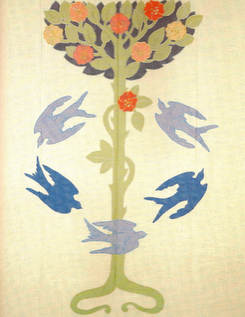
The Tree of Life by Godfrey Blount

A comment on my last post got me thinking about the “swallows and rose tree” below.  What is the panel supposed to mean?  What is that tree?  Should it have a name more inspiring than the Victoria and Albert Museum's name of 'hanging'?  So I have decided to rename it!  The tree is a recurring symbol for Blount's work.

Tree of Life by Godfrey Blount, 1896
Victoria and Albert Museum
I had thought that the tree was a tree…but upon closer inspection, the thorns going up the trunk would suggest that this is a ‘rose tree’.  However rose trees do not really have thorny trunks, or multi-coloured rose flowers (at least not in 1896!).  Reading through some of Blount’s books, he advocates designing fantasy trees, and I believe that is what he was doing here:
  
“If you want to introduce more than one sort of leaf into your spiral, there is no objection to your doing so, so long as your stalks and leaves are not too much like real stalks and real leaves.  We should certainly be shocked if we found figs and thistles growing on the same bough, because we know they grow on different plants.  If we do not want the gardener to criticise our design we must plant trees that never grew in his garden; then perhaps he may learn to admire even if he cannot understand
Sursum Corda ("Lift up your hearts") by Godfrey Blount
from The Studio, vol 29

"…The liberty we may take with… whether we may put a thing in a position or attitude it cannot maintain in Nature, depends on its relative importance to the whole design, and the use that design is to be put to.  It would be absurd to plant an image of the Tree of Life upside down in the centre of a design, but we may allow some eccentricity of shape and attitude in the more conventional border round it; and so long as the freaks of our fancy remain subordinate to the whole scheme of decoration, we must not criticise them too scientifically."

In all three examples of peasant tapestries depicting trees, the roots of the trees are shown differently.  In the V&A's hanging, the roots are curved underneath the tree (as in the illustration of the vase from Arbor Vitae below), in Sursum Corda (above) the roots are angels wings, and in the tapestries on the Blount bed (below) they are splayed out.  Blount continues by saying "…The realist is more attracted to Nature’s results than to her means, to the flower more than the leaf or bud, to the satisfaction of desire more than to the anticipation of it…What a poor sort of compromise with Nature your modern artist thinks of such trees, with their stiff stem, their pair of stubborn branches, and half a dozen leaves!  …How could we find a better natural illustration of that characteristic of traditional Art on which I like to lay so much stress: that infinity within finite limits: that tree of ancient pedigree whose every branch is rooted in the centre of the universe, and carries a host of leaves and the seeds of a thousand generations!” 
Detail of Godfrey Blount bed hanging
from Artist, vol XX, 1897

So here Blount appears to be advocating a mixture of art and nature to produce a more inspiring tree: "All undertakings which are firmly rooted in deep soils of security and truth become trees of life, pillars of strength and support, an issue in wide-spreading shelter of praise and aspiration.  The tree, with its ubiquitous illustration of these thoughts, has naturally become their lasting symbol…Look at a forest tree, and see the single sweep of outline that gathers all it contains in one huge oval, and says to the aspiring and final twig on every branch, “Thus far, and no farther.”  If you will prune your arabesques in the same gardener-like way, you will feel how necessary this severity is to bring out the force and contrast of their essentially meandering character.


from Blount, Godfrey, Arbor Vitae, Arthur Fifield, 1899

"...The tree is a source of myth and decoration that has been universally accepted, from its frequency and obvious analogy, not only to our life, but to every religion and institution in which mankind has been interested
from Blount, Godfrey, Arbor Vitae, Arthur Fifield, 1899

"...We can never divorce the history and practice of Art from the idea of the growth of some living thing, and it is the tree which has been throughout this essay a type, in my mind, of the way in which Art has grown and flourished, and of the way also in which every one of us may cultivate the Art instincts in himself.  Whether it is regarded then, as the symbol of our own or of other life and work, or as a type of that inner existence which is just as real to us, our faiths and our thoughts, the tree, if it is a stout one, is rooted in the soil of solid facts, that is to say, material necessities, popular demands, or, if you will have it so, the will of God or the inevitableness of fate.  Soon its fibres are welded together in co-operative unity to lift its hope out of the dark and mysterious chambers of its birth, to cope with its storm and rain and sunshine.
from Blount, Godfrey, Arbor Vitae, Arthur Fifield, 1899
Illustrating that an inverted tree is like a vase

"...If we turn the tree...upside down, we shall obtain a simple form of bottle or vase which is itself the root of a vast family of traditionally decorative ideas, whose chief significance is seen when flowers or a plant grow out of it.  It is then evidently the earth obedient to God’s command on the third day, bringing forth her verdant offspring

"...On the main facts of life we cannot quarrel, because we must always submit to them.  We must take this as the first meaning of the tree symbol.
from Blount, Godfrey, Arbor Vitae, Arthur Fifield, 1899

“...its central head and laterally uplifted arms suggest the figure most associated in our minds with the Christian religion – the attitude of crucifixation, or of supplication and submission to the All-Father’s will…their accidental imitation or suggestion of other tricks and actions which in more organic life are full of significance and meaning.”

The rose or creeper climbing up the tree evokes the serpent in the garden of Eden.  In other trees designed by Blount, the climber is ivy or snake-like as in the illustration above.  Blount says “the ivy, twisting round the trunk, is the serpent, genius of the soil, earth spirit, symbol of cunning craft, dividing spiral, promising us wisdom, rewarding us with dust; tempting us to taste, to be as gods, and to suffer with them."
from Blount, Godfrey, Arbor Vitae, Arthur Fifield, 1899

At the conclusion of Arbor Vitae Blount states:  “We cannot any longer separate religion from Art.  What we believe, what we love, what, even, we should like to believe and love, we must put into some sort of shape, make some sort of creed or confession of, however loosely worded.  And if we have nothing at first to say, let us waste no time in vain regret, but try and throw ourselves open to every natural influence we can – bird and beast and creeping thing, wind and rain and sun, mountain, river and forest, and crown ourselves laureates to Nature, Poets of the Poor.  We cannot paint till we can feel ; when we can feel, we can paint or sing with ease.”
from Blount, Godfrey, Arbor Vitae, Arthur Fifield, 1899
Dove formation similar to the V&A's hanging

Following in this religious vein, in Science of Symbols (Blount, Godfrey, Arthur Fifield, 1905) Blount states "It is useless to kick against the pricks, against the overwhelming evidence of God.  If Nature reminds us of God, then indeed is Nature the symbol of God.  The Tree, the Stone, the Animal, the roughly hewn idol, image, or totem

"..So far from closing our eyes to facts because all facts are wicked, we must open our enlarged eyes to them because they have become symbols.  Christ has brought about a new dispensation by bringing life into the world an d making what was dead before, alive.  Now, sun and air and cloud and tree and stone and stream cry, “Hosannah to the Highest.  Blessed is he that cometh in the name of the Lord.”

Saturday, 18 June 2011

A Peasant Rest?

Having now understood the meaning behind Godfrey Blount's piece in the Victoria and Albert Museum, 'The Spies', it is clear to me that the other piece in the Victoria and Albert Museum that is referred to as The Spies elsewhere (and I have called The Spies on my blog!) should not be called so.  It appears much more similar to other Blount tapestry pieces that were used in bedroom furnishings.


The Victoria and Albert Museum have informed me that the hanging was purchased from Sotheby's Belgravia in April 1978.  It is 210cm x 180cm.


Hanging by Godfrey Blount, 1896
Victoria & Albert Museum


Linda Parry explains the evolution of bedroom style of the 1890s in the Textiles of the Arts & Crafts Movement (Thames & Hudson, 2005): "Printed cottons with white and pale grounds were increasingly used throughout the house, and more attention was given to bedrooms.  Heal's, famed for its hygienic mattresses, sold a range of suitable bedroom furnishings including printed cotton and silk bedcovers.  They also sold applique hangings from Haslemere which were acceptable hygienically because they were made from washable linen."  At the Paris Exhibition in 1900 (Exposition Universelle), Heal's exhibited a pair of oak bedsteads with the "covers and hangings of Haslemere 'Peasant Tapestries'" (Parry, 2005).  
Godfrey Blount bedcovers and hangings, exhibited by Heal's at 1900 Paris Exhibition,
 Parry, Linda, 
Textiles of the Arts & Crafts Movement, Thames & Hudson, 2005
In 1897 the Artist (vol. XX) published a picture of an oak bedstead designed by Ethel Blount with tapestries designed by Godfrey Blount.  The similarity between the tree and bird design in this picture and the Victoria and Albert Museum's hanging is striking.  In later years there is no mention of beds being made by the Peasant Arts Industries. 

Oak bedstead designed by Ethel Blount, head, foot and quilt peasant tapestry
designed by Godfrey Blount from
The Artist, November 1897
The Godfrey Blount tapestry held by the Haslemere Educational Museum is a bed hanging donated by Mrs Helena Gertrude King's (Joseph King's second wife's) housekeeper, Mrs Tuffs in 1999.


Godfrey Blount Drapery.
Reproduced courtesy of Haslemere Educational Museum


Presumably the Victoria and Albert Museum's hanging at 210cm x 180cm would be too big to have formed a headboard, but perhaps it could have been for a bedspread?  Or maybe it was just designed for a hanging.


Related Posts Plugin for WordPress, Blogger...